
Home›Email marketing tips›When should you send your B2B emails?
When should you send your B2B emails?
On this page
On this page
- The “Tuesday 10 am” myth and what the data really says
- The days that perform in B2B, and the ones to forget
- The time slots that capture attention at the office
- The right time depends above all on the type of email
- Why timing weighs less than you think
- Send Time Optimisation: let the data decide
- Timing and deliverability: the link nobody mentions
- How to find your best time
- Frequently asked questions
In brief: In B2B, Tuesday, Wednesday and Thursday mornings capture the most opens, around 9-11 am. But the universal “best time” does not exist. The type of email and the real behaviour of your contacts weigh more than the clock.
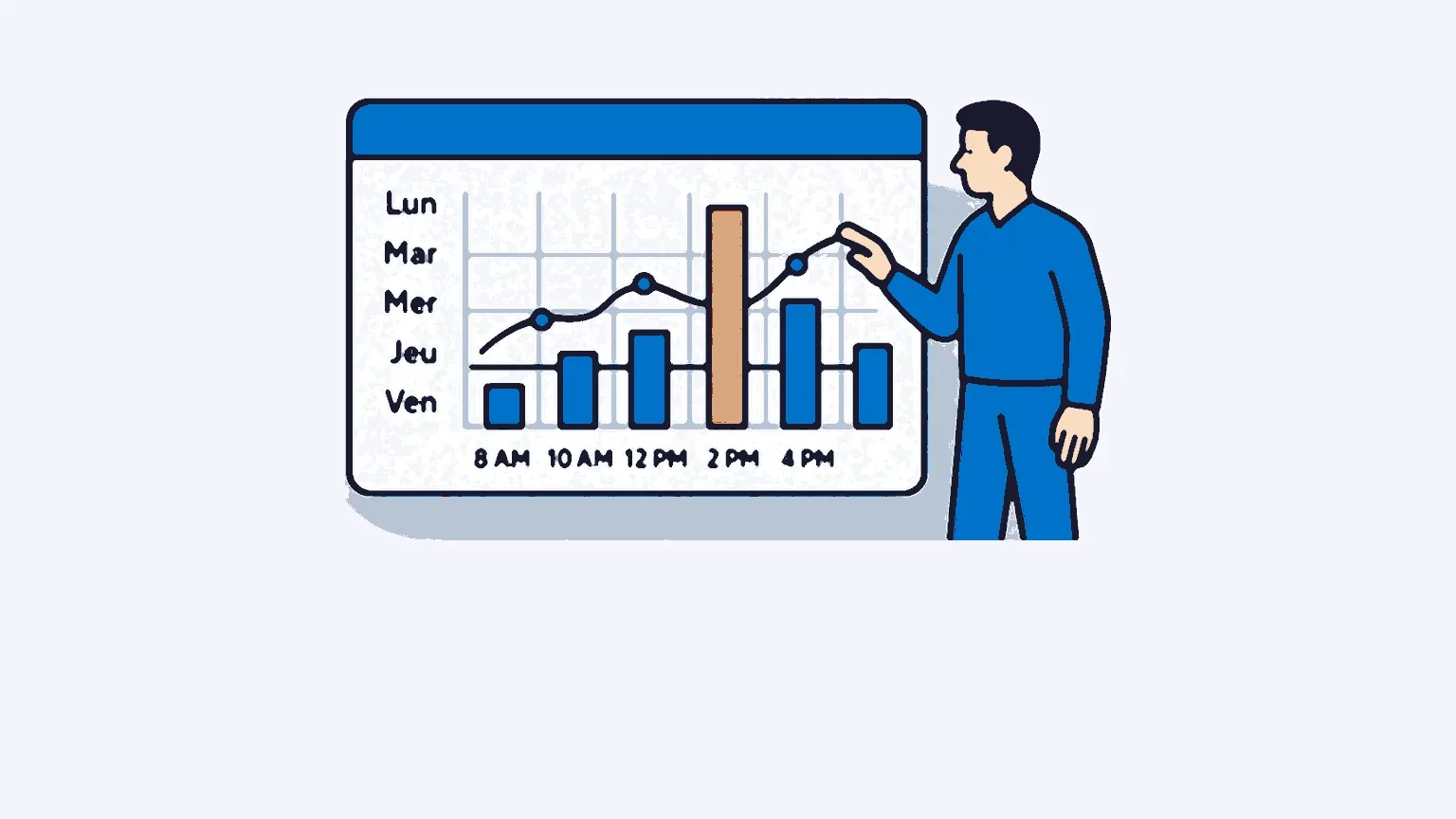
Type “best time to send an email” into Google and you will come across the same answer everywhere. Tuesday, 10 am. The figure has been circulating for years, copied from article to article. It is not wrong. It is just incomplete, and it makes you miss the essential.
Send timing matters, but not as much as claimed. A GetResponse study covering more than 4 billion emails shows that the gaps in open rate between weekdays remain moderate. What really changes is the exposure window. And there, the send time plays a direct role.
The “Tuesday 10 am” myth and what the data really says
The strength of this advice is that it is repeated by all the major platforms. Brevo, HubSpot, Mailchimp and Litmus reach roughly the same conclusions. Its weakness is that this data all comes from emailing software vendors. No independent body publishes a neutral reference on the subject. The figures converge, but they also serve to sell features.
Second nuance, more technical. Since 2021 and the arrival of Apple Mail Privacy Protection, open rates have been artificially inflated. Apple preloads tracking pixels, which counts opens that never took place. GetResponse, to its credit, points this out honestly in its reports. Practical consequence: reason more on your click rates than on your opens alone when judging a time slot.
“Tuesday 10 am” is therefore a good starting point. Not a truth set in stone.
The days that perform in B2B, and the ones to forget
In B2B, the rhythm follows the working week. Your recipients read their emails at the office, between two meetings, rarely at the weekend. The available data all points in the same direction.
| Day | B2B relevance | Why |
|---|---|---|
| Monday | Low | Inbox saturated after the weekend, a day of meetings |
| Tuesday | High | The most cited for opens and clicks |
| Wednesday | High | Good reply rate, particularly in cold prospecting |
| Thursday | High | High engagement before the end of the week |
| Friday | Low | Attention waning, minds already turned to the weekend |
| Weekend | Avoid | Very little professional consultation |
HubSpot reports in its State of Marketing that Tuesday comes top of the engagement days cited by marketers. A Belkins study on cold prospecting emails puts Wednesday ahead for reply rate. The Tuesday-Wednesday-Thursday trio is the consensus.
Monday poses a simple problem. Your prospects open a full inbox and sort in haste. Your message risks being deleted along the way. Friday suffers from the opposite effect, attention slackens. These two ends of the week are not to be banned, but they require a truly punchy subject line to work.
The time slots that capture attention at the office
The time counts more than the day, because it determines where your email sits in the inbox at the moment of consultation. Litmus, after analysing nearly 8 billion opens, places the peak between 10 and 11 am. Brevo, on French campaigns, identifies two windows: 10 am at the start of the day, then 3-4 pm after lunch.
The reasoning is intuitive. In the morning, your target processes their emails before moving on to the day’s tasks. Early afternoon corresponds to a calmer resumption, conducive to reading less urgent content. An in-depth mailing, a white paper, an invitation to a webinar find their place in this second slot.
One figure deserves your attention. GetResponse observes that nearly 21% of opens and more than 44% of clicks on a campaign occur in the first hour after sending. In other words, if you miss the moment your contact checks their inbox, your email slides down the pile and its email open rate collapses mechanically. The issue is not so much the ideal time in absolute terms as the coincidence between your send and the moment of reading.
The right time depends above all on the type of email
Here is what most articles forget. Not all emails are equal, and neither is their ideal schedule. A cold prospecting email does not follow the same logic as a loyalty newsletter.
- Cold prospecting: aim for midweek, early in the morning. You want to arrive at the top of the pile before your prospect gets swept up in their day. Tuesday or Wednesday around 8-9 am works well.
- Nurturing and automated sequences: the fixed day matters less. It is the behavioural trigger that commands, for example the download of a piece of content or the visit to a page. The email goes out at the right time for that specific contact.
- Sales follow-up: align it with your contact’s rhythm. A follow-up ideally goes out 2 to 3 working days after the initial message, avoiding Friday.
- Newsletter: regularity comes before the perfect time. A weekly or monthly appointment, always on the same day, establishes a reading habit among your subscribers.
This distinction changes everything. Looking for “the” best time for all your sends makes no sense. Each type of message has its own window. That is also why a solid B2B email marketing strategy reasons by objective before reasoning by time slot.
Why timing weighs less than you think
Let us be honest about the orders of magnitude. The moment of sending gains you a few percentage points on your opens. It does not double your results. Three levers weigh far more heavily.
The quality of your database first. A clean, segmented list, made up of contacts who have genuinely consented to receive your messages, beats any time slot. The subject line of your email next. It is what decides the open, well before the arrival time. Your sender reputation finally, which determines whether the email even reaches the inbox.
Spending hours optimising the send slot while your database ages and your subject lines lack punch is getting the priorities backwards. Fix the fundamentals first. Timing will then fine-tune a mechanism that is already healthy.
Send Time Optimisation: let the data decide
Since each contact has their own habits, why apply the same time to your whole list? That is the idea behind Send Time Optimisation. The platform analyses each recipient’s engagement history and schedules the send for the moment that person usually opens their emails.
Vendors offering this feature claim gains of 15 to 25% on opens compared with a batch send at a fixed time. These figures come from the vendors themselves, so keep a margin of caution. The principle, however, is sound. Rather than betting on an average, you stick to each person’s real behaviour.
Artificial intelligence pushes this logic even further. It cross-references engagement signals, adjusts continuously and gets around the Apple bias by focusing on clicks and conversions. For a large volume of contacts with varied habits, it is the most operational answer to the famous “it depends”.
Timing and deliverability: the link nobody mentions
One last point, often absent from articles on the subject. The send time does not only affect your readers. It also affects mail servers. Sending a large volume at the precise moment millions of other senders are doing the same means risking the queue at providers such as Gmail or Outlook.
A platform with a robust infrastructure, a high-performance sending engine and dedicated IPs smooths this load and preserves your reputation. At Ediware, the Power-MTA engine handles this sequencing so that volume never turns into a deliverability penalty. The right time on the reader’s side is useless if the email is stuck on the way.
How to find your best time
General statistics give a direction. Your own data gives the answer. No study knows your audience as well as your campaign history.
Start by analysing your sending statistics. Identify the slots that generate the most opens and above all clicks over your last few months. You will see trends there that market averages ignore, specific to your sector and your list.
Then test. The most reliable method is to A/B test your send times on comparable segments. Send the same campaign to two groups, at two different times, and measure the gap on a volume large enough for the result to be significant. Repeat the operation over several sends before concluding. A single campaign proves nothing.
The best time to send your B2B emails is not a box to tick. It is the result of continuous learning, specific to your database and your objectives. Start from the Tuesday-to-Thursday morning consensus, then refine with your figures.
Frequently asked questions
What is the best day to send a B2B email?
Tuesday, Wednesday and Thursday come out on top in the majority of platform analyses. Tuesday is most often cited for opens, Wednesday for reply rates in cold prospecting. Monday and Friday remain less favourable in a professional context.
What time should you send a B2B prospecting email?
The morning between 9 and 11 am captures the most opens, with the peak often around 10 am. For cold prospecting, an earlier send, around 8-9 am, puts you at the top of the inbox before the day’s rush. Early afternoon, around 3 pm, forms a second credible slot.
Should you send B2B emails on Friday?
Friday is not off-limits, but your targets’ attention drops as the weekend approaches. Reserve this day for messages with a particularly strong subject line, or for in-depth content. For an important campaign, Tuesday or Thursday remains safer.
Does send timing influence deliverability?
Yes, indirectly. Sending a large volume at peak times, when many senders are hitting the same servers, can lengthen the queues at mailbox providers. A high-performance sending infrastructure smooths this load and protects your sender reputation.
Is Send Time Optimisation really worth it?
For a large database with varied habits, yes. Instead of applying an average time to everyone, the platform sends to each contact at the moment they usually open their emails. The announced gains are around 15 to 25% additional opens, to be weighted according to your audience.
Related articles
Interactive email: AMP, embedded forms and micro-conversions
AMP for Email, embedded forms and carousels: what interactive email can do in B2B, which email clients display it and how to plan the fallback.
9 min read Email marketing tipsThe complete guide to B2B email A/B testing
B2B email A/B testing has its own rules: small lists, long cycles, narrow segments. Here is how to test properly, read results and learn from every send.
17 min read Email marketing tipsWhen to send B2B emails: the slots that really generate opens
EmailScope data from 97,000 French B2B campaigns overturn conventional wisdom: the best open rates come in the late afternoon, not on Tuesday morning.
7 min read Email marketing tipsPreparing your website for an effective landing page
A landing page is built for a single action. How to prepare your website for an effective landing page: offer, form, speed and the path from email to.
10 min read