
Home›B2B email marketing›Marketing automation
Marketing automation: definition, how it works and B2B guide
On this page
On this page
- Marketing automation is not just automatic emails
- How a scenario works: trigger, condition, action
- What marketing automation changes in concrete terms in B2B
- The B2B scenarios that really pay off
- Lead scoring, the fuel for your scenarios
- Where marketing automation damages your deliverability
- GDPR: the legal basis of your automated scenarios
- When to switch from simple emailing to marketing automation
- Choosing your marketing automation platform
- Frequently asked questions about marketing automation
In brief: Marketing automation triggers your emails and SMS according to each contact’s behaviour. In B2B, it shortens long sales cycles, aligns marketing and sales, and saves several days a month. Here is how it works and when to adopt it.
Marketing automation is not just automatic emails
Many managers reduce marketing automation to an improved autoresponder. That is an incomplete view. Scheduling a newsletter to go out every Tuesday is not automation. It is planning.
Marketing automation, strictly speaking, consists of triggering marketing actions in response to a contact’s behaviour. A prospect downloads a white paper, they receive a tailored sequence. A customer has not opened your last three messages, they move into a reactivation scenario. The logic is no longer “when” but “if”. If a given condition is met, then a given action is triggered.
This nuance changes everything. You are no longer running a sending calendar, you are running journeys. Each contact advances at their own pace through a chain of messages that depends on what they do, not on a fixed date decided in advance.
In B2B, this distinction takes on particular importance. The sales cycle often stretches over several weeks, sometimes several months. A prospect does not sign after one email. They compare, they consult their colleagues, they hold off. Marketing automation makes it possible to maintain this long relationship without mobilising a sales rep at every step.
How a scenario works: trigger, condition, action
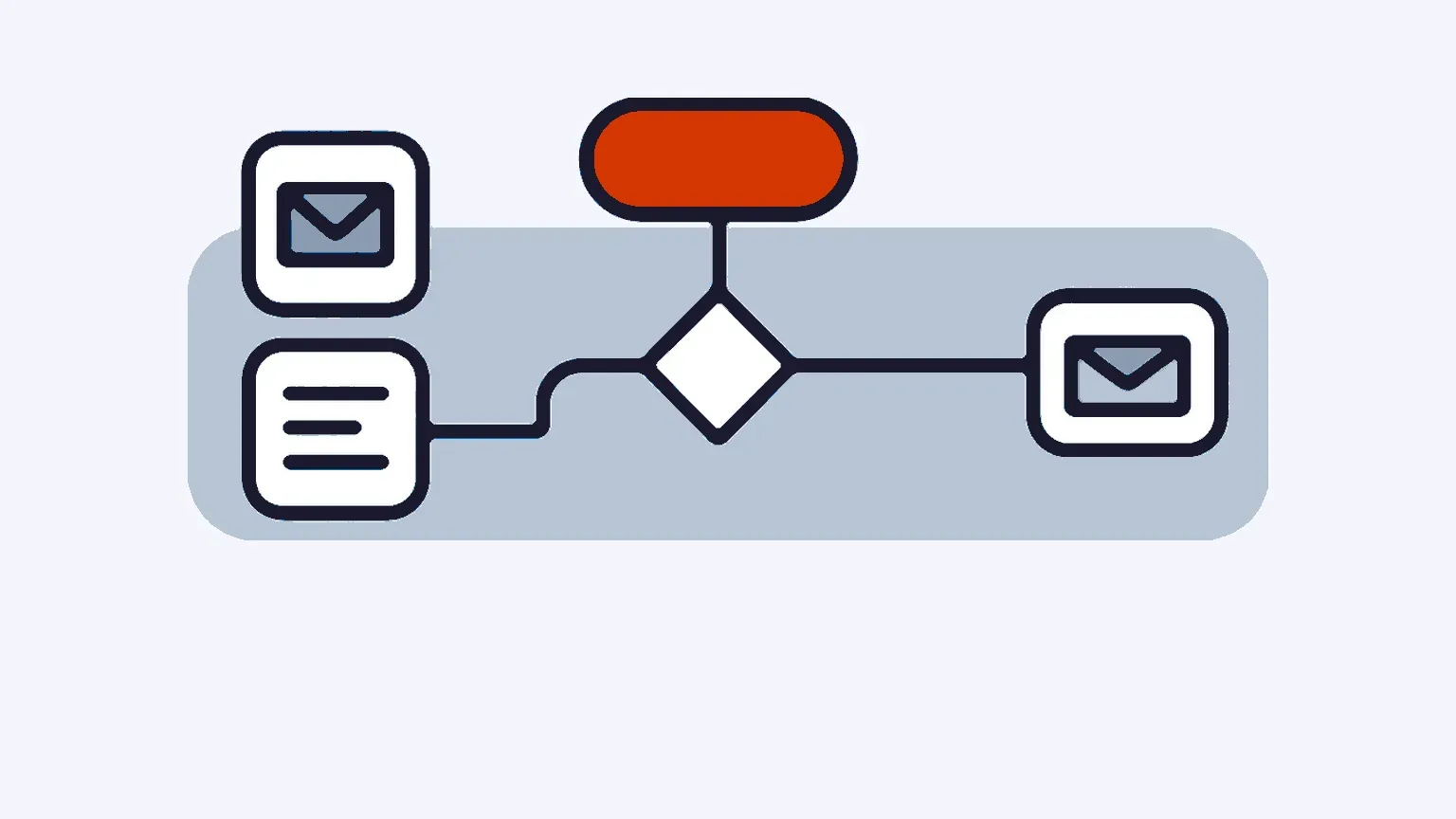
Every automation scenario rests on three building blocks. The trigger starts the journey. The condition routes the contact according to their profile or behaviour. The action sends the right message at the right moment.
The trigger is the starting point. A form sign-up, a click on a specific link, a visit to a pricing page, a contract anniversary date. As soon as the event occurs, the contact enters the workflow.
The condition refines the path. Take a prospect who downloads a guide on deliverability. If they hold a technical position, you send them in-depth content. If they run a marketing team, you focus on business benefits. The same trigger produces two different journeys.
The action, finally, materialises the communication. An email, an SMS, the assignment of a score, a notification sent to the sales rep, the addition of a tag in the database. A complete platform orchestrates these actions across several channels from a single dashboard.
A well-designed workflow looks like a tree. Branches that split, waiting periods between two messages, journey exits when the contact reaches their goal. Nothing obliges you to send seven emails to everyone. The prospect who requests a quote on the second message leaves the nurturing sequence. They no longer need convincing.
What marketing automation changes in concrete terms in B2B
The first gain is time. According to the B2B digital marketing barometer published by the French vendor Plezi, teams that deploy an automation strategy recover the equivalent of one to three working days per month. This freed-up time does not vanish, it is reinvested in strategy and in the commercial relationship.
The second gain concerns returns. A Nucleus Research study published in 2021 put the return on marketing automation at $5.44 for every dollar invested, with payback in under six months. The figure is dated, but it remains one of the few backed by a traceable methodology. Above all, remember the order of magnitude, not the decimal.
Emails triggered by a behaviour clearly outperform bulk sends. The Data & Marketing Association observes that automated flows generate far higher revenue than one-off campaigns sent to the whole database at once. No surprise there. A message that arrives at the moment the prospect is interested always has more impact than a generic send on Tuesday morning.
There is a third effect, more discreet but decisive in B2B: alignment between marketing and sales. When a prospect crosses an engagement threshold, the sales rep receives an alert with the full history of interactions. They call a target that is already ripe, instead of running through a cold pitch. Marketing stops producing leads that nobody calls back.
The B2B scenarios that really pay off
The examples you come across everywhere, abandoned basket and birthday email, come from e-commerce. They speak poorly to B2B. Here are the workflows that produce concrete results for a company selling to other companies.
The welcome sequence. A new contact signs up, they receive a series of messages that present your expertise and lay the foundations of the relationship. Simple to set up, it is often the scenario with the best open rates.
Post-trade-show nurturing. You come back from a trade show with two hundred business cards. Rather than a single, quickly forgotten email, a journey spread over several weeks maintains interest and progressively qualifies the hottest contacts.
The quote follow-up. A prospect has received a proposal and has gone quiet. An automatic follow-up sequence, calibrated without being pushy, recovers a share of the deals that would have gone to competitors through simple oversight.
Reactivating a dormant database. Part of your CRM file has not responded for months. A re-engagement scenario tests these contacts, wakes up those who can be woken and lets you set aside the others to protect your sender reputation.
These mechanisms combine and are refined over time. To go further in building your journeys, our dedicated guide details six B2B marketing automation scenarios that really convert.
Lead scoring, the fuel for your scenarios
A scenario is only as good as the data that feeds it. This is where lead scoring comes in. The principle consists of awarding points according to the contact’s actions and according to their profile.
Opening an email earns a few points. Clicking on a product link earns more. Visiting the pricing page weighs heavier still. On the profile side, a director of a company of the right size in your target sector gets a bonus. Conversely, a generic address or a student on an internship sees their score capped.
When a contact exceeds a defined threshold, they move from marketing-qualified lead to sales-ready lead. That is the moment the sales rep takes over. Not too early, at the risk of burning an immature lead, nor too late, when the prospect has already chosen a competitor.
Segmentation completes the set-up. Slicing your database by sector, company size, engagement level or stage in the buying cycle lets you send each person a relevant message. Sending less, but better targeted, remains the golden rule of B2B emailing.
Where marketing automation damages your deliverability
Here is the blind spot that most guides ignore. Automating without monitoring your deliverability amounts to building a fine machine on fragile foundations.
The main risk lies in over-solicitation. A contact caught in three simultaneous scenarios can receive five messages in one week. They tire of it, they stop opening your emails, or worse, they report you as spam. Every complaint degrades your sender reputation, and this reputation determines whether all your future sends reach the inbox.
A poorly segmented scenario produces the same effect. If your reactivation goes out to invalid addresses accumulated over years, your bounce rates explode. Mailbox providers read this signal as the practice of a careless sender.
The remedy comes down to three reflexes. Cap the commercial pressure, by setting a maximum number of messages per contact per period, across all scenarios. Clean the database upstream of every reactivation journey. Rely on a solid sending infrastructure, with dedicated IP addresses and an engine capable of handling bounces intelligently. On this last point, platforms that pool their IPs expose your reputation to the bad practices of other senders.
We have detailed the most frequent pitfalls in an article on the mistakes to avoid in marketing automation. Deliverability occupies a central place there, because it decides the fate of all your scenarios.
GDPR: the legal basis of your automated scenarios
In France, no scenario is exempt from the regulatory framework. A workflow that sends messages without a clear legal basis exposes you, whatever its technical sophistication.
Every journey must rest on an identified foundation. Consent for prospecting aimed at individuals. Legitimate interest, within a defined framework, for part of B2B prospecting. Performance of a contract for messages linked to an existing customer relationship. A welcome scenario triggered after a voluntary sign-up poses no problem. A sequence targeting purchased addresses with no legal basis does.
The retention period also matters. Keeping inactive contacts in your scenarios indefinitely contradicts the principle of data minimisation. It is, incidentally, one more good reason to plug a reactivation journey, followed by deletion, onto contacts who have not responded for a long time.
The choice of platform plays a direct role here. A solution that hosts your data in France, natively GDPR-compliant, considerably simplifies your compliance. You avoid the questions of data transfers outside the European Union, which complicate the lives of many marketers working with American tools.
When to switch from simple emailing to marketing automation
Not every company needs automation from day one. The question is not whether the tool is powerful, but whether you are ready to exploit it.
A few signals indicate the right moment. Your database has outgrown the artisanal stage and you can no longer segment by hand. Your sales reps complain of cold or poorly qualified leads. You repeat the same manual sends every week and time is running short. You want to track your prospects’ behaviour to prioritise your follow-ups.
Conversely, if you are starting out with a small list and one-off campaigns, begin by mastering classic emailing. Deliverability, the quality of your database, writing effective subject lines. Automation will amplify these fundamentals, it does not replace them.
The transition happens seamlessly with a unified platform. You can test a first simple scenario, a welcome sequence for example, then expand as you find your feet. To take this step, find out how to automate your B2B email campaigns with a tool designed for the French market.
Choosing your marketing automation platform
The market is full of tools, from mass-market generalists to overpriced enterprise suites. For B2B use, a few criteria make the difference.
| Criterion | What to check |
|---|---|
| Deliverability | Dedicated IPs, robust sending engine, bounce management |
| CRM integration | Synchronisation of contacts and scores with your sales tool |
| Compliance | Data hosting in France, natively GDPR-compliant |
| Multichannel | Email and SMS orchestrated within the same scenario |
| Support | Human assistance, in French, included in the offer |
| Commitment | Contractual flexibility, no long-term commitment |
CRM integration deserves particular attention in B2B. Without it, your engagement scores stay locked in the marketing tool and your sales reps work blind. We have devoted an entire guide to CRM and B2B emailing integration, so much does this point determine the return on your scenarios.
One last practical piece of advice. Test before you commit. A platform that offers use with no commitment and credits that never expire gives you time to try out your first scenarios without pressure. It is often the best way to check that a tool really suits your organisation.
Frequently asked questions about marketing automation
What is the difference between email marketing and marketing automation?
Email marketing sends a message to a list at a moment you choose. Marketing automation triggers messages in reaction to each contact’s behaviour, according to rules defined in advance. One runs a calendar, the other runs individual journeys that adapt in real time.
What is a workflow in marketing automation?
A workflow is the visual representation of a scenario. It chains a trigger, conditions and actions in the form of a tree. Each branch corresponds to a possible path depending on what the contact does. The workflow decides who receives which message, at what moment, and when to exit the journey.
Is marketing automation suitable for very small businesses and SMEs?
Yes, provided you already have a qualified contact database and regular campaigns. A small organisation saves a lot of time on simple scenarios such as welcome or follow-up. There is no need to aim for complex workflows from the outset, the tool is exploited progressively.
How much does a marketing automation solution cost?
Prices vary according to sending volume and features. In B2B, expect a monthly subscription that includes automation, scenarios and tracking. Beware of offers where automation, dedicated IPs or French-language support come as extras. A low entry price sometimes hides additional costs.
Does marketing automation harm deliverability?
Used badly, yes. Over-solicitation and scenarios launched on invalid addresses degrade your sender reputation. Used well, it improves it, because targeted messages generate more engagement and fewer complaints. It all depends on capping the pressure and on the quality of your database.
Is consent required for every automated scenario?
In France, every scenario must rest on a legal basis. Consent is required for prospecting aimed at individuals. Legitimate interest governs part of B2B prospecting. Messages linked to a customer contract fall under the performance of that contract. A scenario triggered after a voluntary sign-up poses no difficulty.
Related articles
Customer onboarding by email: building a sequence that converts
An onboarding email sequence takes a new B2B customer from Day 0 to Day 30: timeline, examples by sector, the metrics that matter and the legal framework.
13 min read B2B email marketingCRM and B2B emailing: the essential integration
Connecting your CRM to your emailing platform means richer segmentation, the right message at the right stage of the sales cycle and GDPR compliance.
9 min read B2B email marketing5 common marketing automation mistakes
Workflows launched without a strategy, a neglected database, ignored sending pressure, stale scenarios, overlooked GDPR: five mistakes and how to fix them.
7 min read Email marketing tipsEmail marketing: harness the potential of your clickers
Clickers are the contacts who already showed interest. How to harness their potential with targeted follow-ups, and turn a click into a conversation.
18 min read