
Home›B2B email marketing›B2B marketing automation scenarios
B2B marketing automation: 6 workflows that really convert
On this page
On this page
- Why a B2B scenario has nothing to do with a B2C scenario
- The 6 scenarios that really produce results in B2B
- Building a scenario that passes the deliverability test
- The indicators that show a scenario is working
- The mistakes that sink 8 scenarios out of 10
- How to get started without building a monster
- FAQ: your questions on B2B marketing automation scenarios
In brief: 6 B2B marketing automation scenarios that produce qualified leads, from the welcome series to multi-decision-maker follow-up. With the KPIs to track and the mistakes to avoid so you don’t burn your sender reputation.
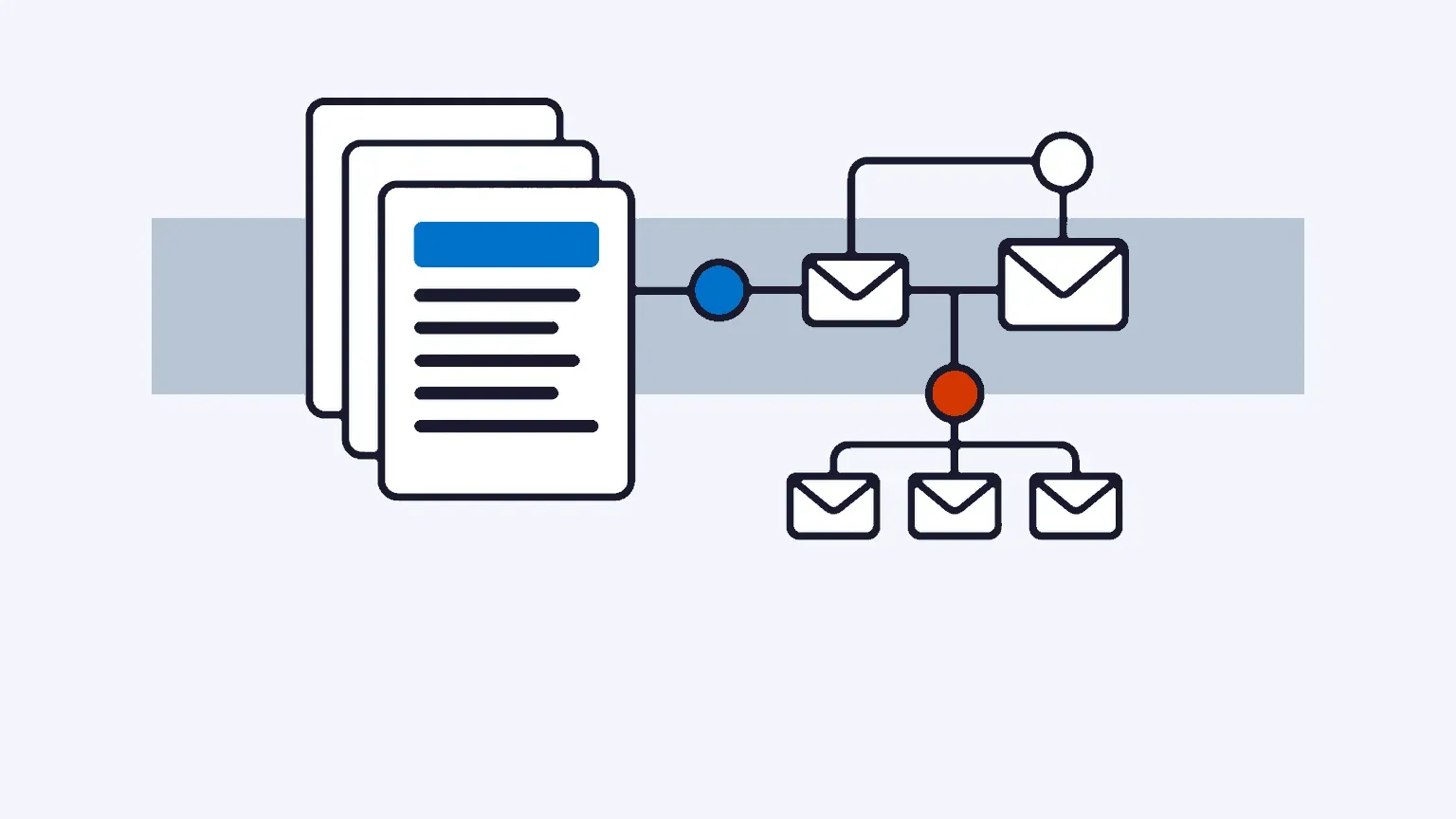
Type “B2B marketing automation scenarios” into Google and you land on ten lists of “11 essential workflows”. Endless recycling. Endless confusion between B2B and e-commerce. As if the buying journey for a €30,000 piece of software spread over 18 months could take its cue from a basket abandoned on a Tuesday evening in a shoe shop. This article takes the opposite view. We are talking here about the workflows we have actually seen running at B2B clients for twenty years, the ones that produce qualified leads, not badges for logging into a tool. And above all, about the indicators that let you decide between a scenario worth continuing and one better switched off.
Why a B2B scenario has nothing to do with a B2C scenario
Marketing automation exploded on e-commerce models. Welcome series, abandoned basket, post-purchase follow-up. These scenarios work because the decision is quick, individual and emotional. In B2B, none of that applies.
B2B buyers spend only 17% of their buying journey in direct contact with sales reps, according to Gartner research on 750 buyers involved in complex purchases. The rest plays out autonomously, on digital channels, among several people (CEO, CFO, CIO, business line), over cycles that can exceed 18 months for enterprise SaaS software.
Direct consequence: a B2B automation scenario must nurture the prospect over time, segment by decision-maker profile, and know when to step aside so the sales rep can take over. It is not an enhanced autoresponder, it is a mechanism of prolonged presence that adapts to behaviour.
The investment is not marginal. The Total Economic Impact study conducted by Forrester Consulting for Adobe Marketo Engage in 2023 measures an average ROI of 267% over 3 years, with payback in under 3 months for the composite organisation modelled. The Plezi barometer of B2B digital marketing in France (2024 edition) confirms the momentum on the French side: 63% of B2B marketers see a positive impact from automation on their lead generation within 6 months. The figures converge. What remains is to know which scenarios to deploy first.
The 6 scenarios that really produce results in B2B
Here is the selection we see outperforming in demanding B2B accounts. Each answers a precise sales mechanism, not a passing fad.
The qualifying welcome sequence
This is not the simple “thank you for signing up”. It is a mini-sequence of 3 to 5 emails over 10 to 15 days that pursues three objectives at once: qualify the need, segment the profile, and initiate the sales relationship.
The first email delivers the promised resource (white paper, replay, product access). The following ones ask implicit questions through their content: “Are you more in B2B key accounts or very small businesses?”, “What is your main blocker right now?”. Each click, each page viewed feeds the scoring.
The figures speak for themselves. Welcome emails show an open rate of 50 to 60%, roughly three times the average of a classic broadcast campaign, according to the GetResponse 2024 benchmarks. The top 10% of welcome flows generate more than $21 of revenue per recipient in the Klaviyo 2024 panel. On a B2B cycle, you do not measure direct revenue but the conversion rate to MQL: around 8 to 12% among our clients who take the trouble to really qualify.
The classic trap: sending the same content to a CFO and an HR director. Address the same need from two different angles and you double your engagement.
Long-cycle nurturing adapted to maturity
This is the scenario that separates serious B2B from amateurism. You know a prospect has downloaded a white paper on the ROI of automation. Their decision will be made in 6 to 18 months. What do you do in the meantime?
Progressive maturity nurturing chains three phases. The TOFU (top of funnel) phase during the first 4 to 6 weeks: broad content on the business issue, with no sales angle. The MOFU (middle of funnel) phase between 2 and 4 months: case studies, comparisons, methodologies. The BOFU (bottom of funnel) phase from the 4th month if the scoring justifies it: demos, ROI calculator, conversation with the sales rep.
The historic but still-cited Forrester study on lead nurturing, taken up in the Demand Gen Report 2024, indicates that organisations that master this long cycle generate 50% more sales-ready leads at a 33% lower cost. The condition: the sequence must adapt to behaviour, not blindly roll out 12 scheduled emails.
Field advice: never exceed one email every 7 to 10 days on a long sequence. Beyond that, you wear out the contact and damage your email deliverability and infrastructure before the sales rep has even been able to make contact.
Behavioural scoring that triggers a sales rep
Basic lead scoring awards 5 points for a download, 10 for a pricing page visit, 20 for a demo request. At 50 points, the alert lands with the sales rep. That is the 2010 version of marketing automation, still ubiquitous.
The 2026 version layers on a fine-grained behavioural dimension. Three visits to the pricing page in 7 days trigger a real-time alert, regardless of the raw score. A visit outside office hours signals a personal or urgent project. Newsletter open frequency weights the engagement score.
This refinement changes the game for sales reps: they no longer have to call 50 “hot” leads to convert 3. They call 15 genuinely qualified leads and convert 6. The ratio changes the economics of prospecting.
To work, this scenario assumes your platform reports events in real time and allows several criteria to be combined in a trigger condition. Check this point before architecting it.
The multi-decision-maker (buying committee) scenario
Nobody covers this angle in the “11 essential scenarios” listicles. Yet it is the one that turns a B2B opportunity into a signature.
On a complex purchase, your main prospect (often an operational manager) has to convince a buying committee: CEO, CFO, CIO, business line, sometimes HR. Each has their own objections. The CFO wants the quantified ROI, the CIO wants the technical guarantees (GDPR, hosting, integrations), the CEO wants a customer case of their size.
The multi-decision-maker scenario triggers, from a certain scoring level, a sequence with several branches. The main contact receives content to help with the internal decision (“how to present this project to your management committee”). In parallel, persona-specific content (a CFO one-pager, a CIO technical sheet, a CEO customer case) is made available via a shareable link.
B2B marketers who structure these sequences see their MQL → SQL conversion rate climb by 20 to 40%. The reason is simple: you are no longer selling to a buyer, you are arming them to sell internally.
Post-event follow-up
Trade shows and webinars generate hundreds, sometimes thousands of leads in 48 hours. And 80% of those leads are lost in the following 15 days, for want of structured follow-up.
The right post-event scenario segments three distinct populations from the outset. Registrants who attended (they saw the demo, they have strong intent). Registrants who did not attend (declared interest but logistical friction). Stand visitors who did not register (the weakest signal but the largest volume).
For each segment, a sequence of 5 to 7 emails over 45 days. The attendee receives the replay, a customer case from their sector, an offer of a short conversation at D+10. The absentee receives the replay first, with a visual summary. The lukewarm visitor enters a standard nurturing track with authoritative content on the topic covered at the event.
Why 45 days and not 7? Because in B2B, the decision is never made on the way back from the show. It crystallises when the subject comes up in a team meeting, two to six weeks later. That is when you need to be present in the inbox.
Dormant account winback
Different from the classic “contact reactivation” (a contact who has not opened anything for 90 days), B2B winback targets the customer account inactive for 12 months or more. These are your best forgotten prospects: they know you, they have already bought, their thinking cycle will be short if you arrive at the right moment.
The scenario starts with a cohort analysis: which accounts have bought nothing for 12 months but were active before? For these accounts, a sequence of 3 emails over 6 weeks, with a value logic very different from the “we miss you” that never works in B2B.
Email 1: a concrete deliverable related to their sector (report, study, benchmark). No sales mention. Email 2: a look at the product updates relevant to their past usage, with a comparable customer case. Email 3: an invitation to a short conversation with someone they know (ideally their former account manager).
Dormant account winback converts on average between 8 and 15% of the targeted accounts. That is less than warm open prospecting, but infinitely more profitable given the initial acquisition cost already amortised. Well-built automatic follow-ups make the difference in this mechanism.
Building a scenario that passes the deliverability test
A scenario that is brilliant on paper but ends up in spam generates nothing. That is the big difference between the workflows you read about in articles and those that actually run in production.
Three operational principles to build in from the design stage.
No sending spike on a cold cohort. If you activate a welcome sequence on a file of 50,000 contacts imported from a recent acquisition, you blow up your IP reputation. Spread the activation over 2 to 4 weeks, in batches of 1,000 to 5,000.
Explicit exit conditions. Every scenario must provide a way out: no opens on the first 3 emails, unsubscribe, a falling score, or the simple condition “customer conversion completed”. Without that, you keep pushing emails to disengaged contacts, your open rates collapse and the anti-spam filters classify you.
Bounce monitoring within the sequence. Every hard bounce must immediately remove the contact from all active sequences, not just from the sending list. Without that, you pile up bounces and damage your Sender Reputation score.
This is the ground where platform quality makes the difference. An infrastructure with dedicated IPs, continuous monitoring and automatic bounce handling protects your scenarios over time. That is precisely what we offer to automate your Ediware campaigns in B2B.
The indicators that show a scenario is working
Measuring an automation scenario is not about looking at the open rate of the last email. It is about following a chain of KPIs that reveal whether the mechanism really converts.
| Scenario | Trigger | Key KPI | B2B target |
|---|---|---|---|
| Qualifying welcome | Sign-up / download | MQL rate at end of sequence | 8 to 12% |
| Long-cycle nurturing | Initial score > 20 | SQL rate at 6 months | 3 to 6% |
| Behavioural scoring | Combination of signals | Meeting rate on alerted leads | 25 to 40% |
| Multi-decision-maker | Score > 60 + multiple contacts | MQL → SQL conversion | +20 to +40% vs baseline |
| Post-event | Event registration | Meeting rate at 45 days | 4 to 8% |
| Dormant account winback | 12 months’ inactivity | Re-engagement rate | 8 to 15% |
Beyond these specific KPIs, keep a constant watch on three cross-cutting indicators: the unsubscribe rate per scenario (above 0.5% per email, the content is the problem), the spam complaint rate (above 0.1%, the filters will penalise you), and the declining engagement rate across the sequence. If engagement drops by 80% between the first and last email, your sequence is too long or poorly calibrated.
To go further on the scenarios that build on B2B email prospecting, 15 detailed techniques are gathered in our dedicated guide.
The mistakes that sink 8 scenarios out of 10
Scenarios rarely fail for lack of ideas. They fail through poor execution. Here are the recurring traps.
Too many emails in a short window. Five emails in 10 days on a cold cohort guarantees a wave of unsubscribes and spam complaints. Give it air. One email every 5 to 7 days on an onboarding sequence, every 10 to 15 days on nurturing.
No exit condition. The contact who has not opened the first 3 emails will not read the 4th. Take them out of the sequence, or switch them to a low-frequency “wake-up” scenario.
No persona segmentation. Sending the same content to a CFO, a CIO and a marketing manager guarantees that none of them will feel concerned. Segmentation by profile is not a luxury, it is the condition of effectiveness.
Confusing follow-up with harassment. A sales follow-up is not rewritten as 5 versions of the same message 48 hours apart. Vary the angle (social proof, urgency, new added value), genuinely space them out, and accept silence as an answer.
No deliverability measurement across the sequence. If your open rate drops from 45% to 12% between email 1 and email 6, you do not have a content problem, you have a reputation problem. The filters detect fatigue before your dashboards do.
Siloed scenarios that don’t talk to each other. A contact can simultaneously receive a welcome email, a monthly newsletter and a post-event follow-up. That is a sign your scenarios are not talking to each other. Put in place a global sales pressure logic that caps the number of emails received per contact over a rolling 7 days.
How to get started without building a monster
The Plezi 2024 barometer is a reminder: 73% of B2B marketing teams have 1 to 3 people. No point aiming for 15 scenarios from the start. You will spend your days on them and none will really be maintained.
Start with two scenarios at most, chosen according to your stage.
If you have few inbound leads: the qualifying welcome sequence. It makes the most of every sign-up and structures your qualification work.
If you have flow but little conversion: long-cycle nurturing adapted to maturity. That is what produces value over 6 to 12 months.
If you have both: add behavioural scoring, which multiplies the effectiveness of the first two.
Measure for 8 to 12 weeks before adding a third scenario. B2B marketing automation is a cumulative effect: according to the Plezi 2024 barometer, teams see on average +300% MQLs after 6 months of well-structured automation. The secret is not in the number of workflows, but in the quality of their execution.
AI is shaking things up, as everywhere. Salesforce, in its State of Marketing 2024 (10th edition, 4,850 marketers surveyed in 29 countries), puts forward that 75% of teams have already slipped AI into at least one automation workflow. It was under 50% a year earlier. In concrete terms? Writing subject lines and email bodies, recommending content by profile, predicting the best sending slot. Building blocks that are now within reach of a marketing team. But to be steered, not endured: an email “written by an unproofread AI” can be spotted in three seconds, and it will cost you more than it earns you.
FAQ: your questions on B2B marketing automation scenarios
What is a marketing automation scenario in B2B?
It is a series of emails, sometimes doubled with SMS, that triggers on its own when the prospect does something: signs up, downloads a white paper, visits a pricing page. Where a classic campaign goes out to everyone at the same time, the scenario adjusts what follows in real time. Depending on whether the contact opens, clicks or stays silent, the sequence speeds up, slows down, or stops dead.
What is the difference between B2B and B2C marketing automation?
B2C plays on short, individual and emotional cycles (abandoned basket, promo code). B2B runs over 6 to 18 months, involves several decision-makers and rests on the added value of the content. B2B scenarios must last longer, segment by decision-maker profile and accept a higher cost per lead offset by an incomparably higher average order value.
How many scenarios should you deploy to get started?
Two scenarios at most in the first year, well executed and measured. A qualifying welcome sequence and long-cycle nurturing are enough to produce results over 6 months. Add a third scenario only when the first two are stable and performing.
How does lead scoring work in a B2B scenario?
Lead scoring awards points according to the prospect’s actions (download, visit, open). Above a threshold, the contact is considered an MQL (Marketing Qualified Lead) and passed to the sales rep. Modern B2B scoring combines classic points with a behavioural logic (visit frequency, pages viewed, timing signals) to really qualify intent.
How do you automate B2B email prospecting without seeming intrusive?
Three rules. Space out the sends (never more than one email every 5 to 7 days during onboarding). Vary the angles (never 3 identical follow-ups). Provide exit conditions (remove the contact who does not react after 3 messages). A platform with dedicated IPs and reputation monitoring, such as Ediware, completes the arsenal by ensuring your messages really reach the inbox without being classified as sales pressure.
Related articles
Account-based marketing and B2B email: targeting your strategic accounts
Account-based marketing applied to B2B email: choose your target accounts, write to several decision-makers, stay within the rules and measure by account.
10 min read B2B email marketingB2B cold emailing: legal framework and best practices
In France, cold emailing a professional without prior consent is legal under three conditions: named business address, relevant message and easy opt-out.
9 min read B2B email marketingB2B email lead scoring: rank prospects by engagement signals
Lead scoring gives each prospect a score based on profile and behaviour. Your B2B email campaigns supply the most reliable signals: opens, clicks, replies.
8 min read B2B email marketingB2B email prospecting: 15 techniques that really generate leads
Professionals are more solicited than ever, yet email remains their preferred channel. Fifteen B2B email prospecting techniques that really generate leads.
17 min read