
Home›B2B email marketing›B2B email lead scoring
B2B email lead scoring: rank prospects by engagement signals
On this page
On this page
- Lead scoring means scoring in order to prioritise better
- Two families of criteria: who the prospect is, and what they do
- Your email campaigns feed the scoring continuously
- Building your points grid without over-engineering it
- The MQL threshold: when to hand over to sales
- Spotting prospects who are drifting away before you lose them
- Keeping your model alive and adapting it to your size
In brief: Lead scoring gives each prospect a score according to their profile and behaviour. In B2B, your email campaigns deliver the most reliable signals: opens, clicks, replies. Here is how to build a usable scoring model, even without an advanced CRM.
Lead scoring means scoring in order to prioritise better
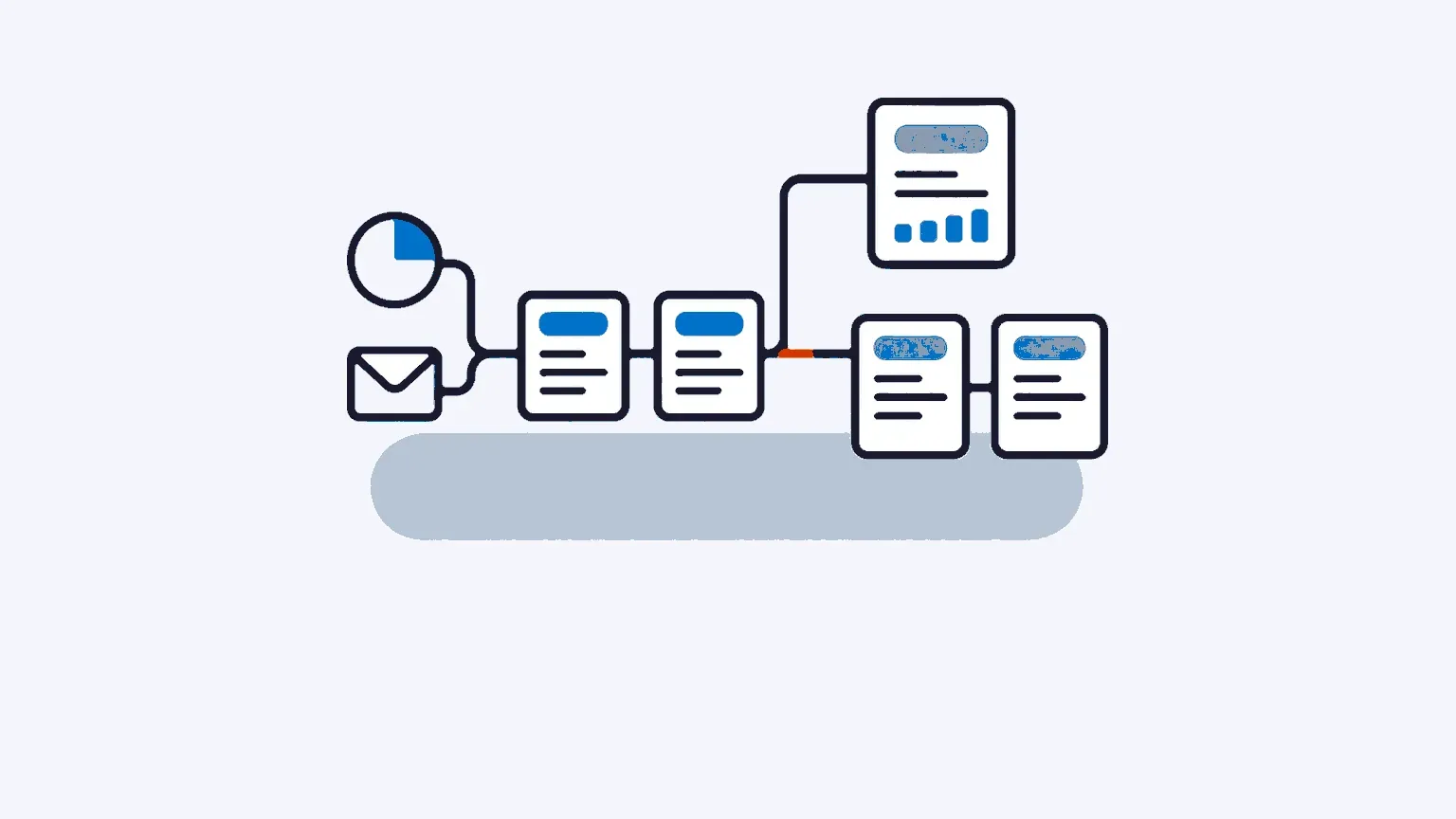
Your sales reps receive a list of contacts. Which ones should they call first? Without a method, they handle leads in order of arrival, or by gut feeling. Lead scoring settles that question. It gives each prospect a score according to two things: who they are, and how they react to your content.
The idea fits in one sentence. The higher the score climbs, the riper the contact is for a sales conversation. A director who opens your last three emails and clicks on your pricing page does not carry the same weight as a generic address that has stayed silent for months.
The problem that scoring solves is one B2B teams know by heart. A significant share of the leads passed to sales do not correspond to a prospect genuinely in a buying phase. As a result, salespeople wear themselves out on lukewarm contacts while the hot opportunities cool down. By prioritising, you concentrate effort where it pays. It is, incidentally, one of the B2B prospecting KPIs that every marketing manager should keep in view.
Two families of criteria: who the prospect is, and what they do
A scoring model always rests on two complementary pillars.
The first is the profile. We are talking here about demographic and firmographic criteria: job title, sector, company size, geographical area, potential budget. These data say whether the contact resembles your ideal customer. The BANT framework, created by IBM in the 1960s and still in use, formalises this approach around four questions: budget, decision-making authority, need, timeframe.
The second pillar is behaviour. Do they open your emails? Do they click? Do they visit key pages? Do they download your content? Where the profile stays static, behaviour moves with every interaction. And it is behaviour that betrays real intent.
| Profile criterion (static) | Behavioural signal (dynamic) |
|---|---|
| Job title and decision level | Opening an email |
| Industry | Clicking on a link |
| Company size | Replying to a message |
| Geographical area | Visiting the pricing page |
| Fit with the ideal customer | Downloading a white paper |
A good score combines the two. A perfect profile without the slightest activity remains a cold prospect. Intense activity on an off-target profile rarely deserves a sales call. It is the balance between the two columns that gives the model its value.
Your email campaigns feed the scoring continuously
Here is what most guides forget. For the majority of SMEs and mid-sized companies, the primary source of behavioural signals is not a sophisticated CRM. It is the emailing platform.
Every campaign you send produces data that can be used straight away. An open is worth one point. A click is worth more, because it reflects active interest. A reply to a prospecting email weighs heavier still. Conversely, an unsubscribe or a message left unopened for weeks lowers the score.
This raw material arrives with no extra effort. You already route your campaigns, the tracking already records the interactions. All that remains is to turn these events into points. A platform that centralises sending and contact tracking gives you the working basis. Provided that the contact segmentation is fine enough to attach each signal to the right record.
The click deserves particular attention. Not all clicks are equal. A click on your case study does not tell the same story as a click on the pricing page or on the demo form. Weighting according to the destination page considerably sharpens the reading of intent.
Recency weighs just as much. A click today is worth more than a click six months ago. Many models neglect this parameter and treat a contact who was active in January as if they still were in June. To correct this bias, let behavioural points decay over time. A recent signal keeps its full value, an old signal gradually fades. This mechanism fits far better with the reality of a B2B buying cycle, where interest rises and falls in waves.
Building your points grid without over-engineering it
An effective scoring model does not need to be complicated. Start simple. Assign points to each criterion, set a total, observe what happens.
Here is an example of a starting grid for B2B prospecting:
| Action or criterion | Points |
|---|---|
| Decision-making role | +20 |
| Company within target (size, sector) | +15 |
| Opening an email | +5 |
| Clicking on a content link | +10 |
| Clicking on the pricing or demo page | +25 |
| Replying to an email | +30 |
| Unsubscribing | -50 |
| No interaction for 60 days | -15 |
The exact figures matter less than their relative consistency. A click on the pricing page must weigh more than a simple open, that is the logic that prevails. And negative scoring counts as much as positive. Without points removed for inactivity or unsubscribing, your database swells with false signals and everyone ends up looking hot.
Test your grid on contacts whose commercial outcome you already know. If your best customers from last year would have earned a high score with your model, you have something solid. If not, adjust the weightings until the score matches reality on the ground.
Once the grid is settled, translate the total score into action tiers. Below a certain threshold, the contact stays in nurturing and continues to receive your campaigns. Above it, they move over to sales. In between, an intermediate zone calls for a targeted follow-up to push them up. Three tiers are enough to start with, feel free to add more as the model matures.
The MQL threshold: when to hand over to sales
Scoring is useless without a trigger threshold. This is the moment a contact moves from simple lead to MQL, a marketing-qualified lead, ready to be worked by sales.
This threshold is negotiated between marketing and sales. And that is often where things get stuck. The 2024 Sales and Marketing Alignment barometer, conducted in France by the CMIT with Nomination, the ISG and the ISEG, shows that 41% of French companies consider their teams aligned, 21 points better than in 2018. But the share of marketers judging the leads passed on to be of sufficient quality fell by 13 points in one year. The main obstacle, cited by 61% of respondents: the absence of shared objectives.
Lead scoring tackles precisely this disagreement, provided the threshold is set together. Forrester confirmed it at the end of 2024: 82% of executives believe their teams are aligned, while 65% of operational staff experience the opposite every day. A common definition of the qualified lead, translated into points, gets everyone to agree on facts rather than impressions. This discipline is part of a broader, structured approach to B2B email prospecting, where every step is measured.
Be careful not to confuse two stages. An MQL is not yet an SQL, the lead validated by sales as a genuine opportunity. Scoring gets the contact up the first step, the human exchange confirms the second. Also plan a feedback loop: when a sales rep requalifies an MQL as a contact that is not ready, the information must flow back to correct the model. Without this safeguard, scoring runs on empty and repeats its mistakes.
Spotting prospects who are drifting away before you lose them
Scoring is not only for spotting hot contacts. It also reveals those who are cooling down.
A prospect who used to open your emails systematically and has not reacted for two months is sending a clear signal. Their score drops mechanically, provided you have built in the inactivity decay. Rather than ignoring them, trigger a reactivation campaign: a message in a different tone, an offer, a direct question.
This declining-score logic avoids two pitfalls. It prevents your database from swelling artificially with inactive contacts counted as active. It also protects your deliverability, because continuing to spray addresses that never open degrades your sender reputation. A contact whose score stays on the floor despite follow-ups deserves to be set aside, not harassed. Scoring also tells you when to let go.
Keeping your model alive and adapting it to your size
A scoring model is never fixed. Your targets evolve, your content changes, your engagement rates move with the seasons. Recalibrate your grid every three to six months by comparing scores with the sales actually closed.
For a very small business or an SME, there is no need to aim for an over-engineered system from the outset. An emailing platform that tracks opens and clicks, coupled with clean B2B marketing segmentation, is more than enough to get started. You create segments by score tier, address each tier differently, and refine campaign after campaign. Predictive models based on machine learning will come later, when the volume of data justifies them.
What matters most is regularity. An imperfect scoring model consulted every week is worth more than a perfect model nobody opens. Start with the signals you already have to hand, your email campaigns, and build from there. The rest will follow.
Related articles
Account-based marketing and B2B email: targeting your strategic accounts
Account-based marketing applied to B2B email: choose your target accounts, write to several decision-makers, stay within the rules and measure by account.
10 min read B2B email marketingB2B cold emailing: legal framework and best practices
In France, cold emailing a professional without prior consent is legal under three conditions: named business address, relevant message and easy opt-out.
9 min read B2B email marketingB2B marketing automation: 6 workflows that really convert
Six B2B marketing automation scenarios that produce qualified leads, from welcome series to buying-committee follow-up, with KPIs and mistakes to watch.
14 min read B2B email marketingB2B email prospecting: 15 techniques that really generate leads
Professionals are more solicited than ever, yet email remains their preferred channel. Fifteen B2B email prospecting techniques that really generate leads.
17 min read