
Home›B2B email marketing›Email open geolocation
Email open geolocation: putting the data to work
On this page
In brief: Email open geolocation relies on the IP address that loads the tracking pixel. It holds up well at country level, gets blurry at city level, and Apple Mail, the Gmail proxy and security filters all distort it. In B2B, it reveals trends. It does not locate a contact.
How an open becomes a dot on the map
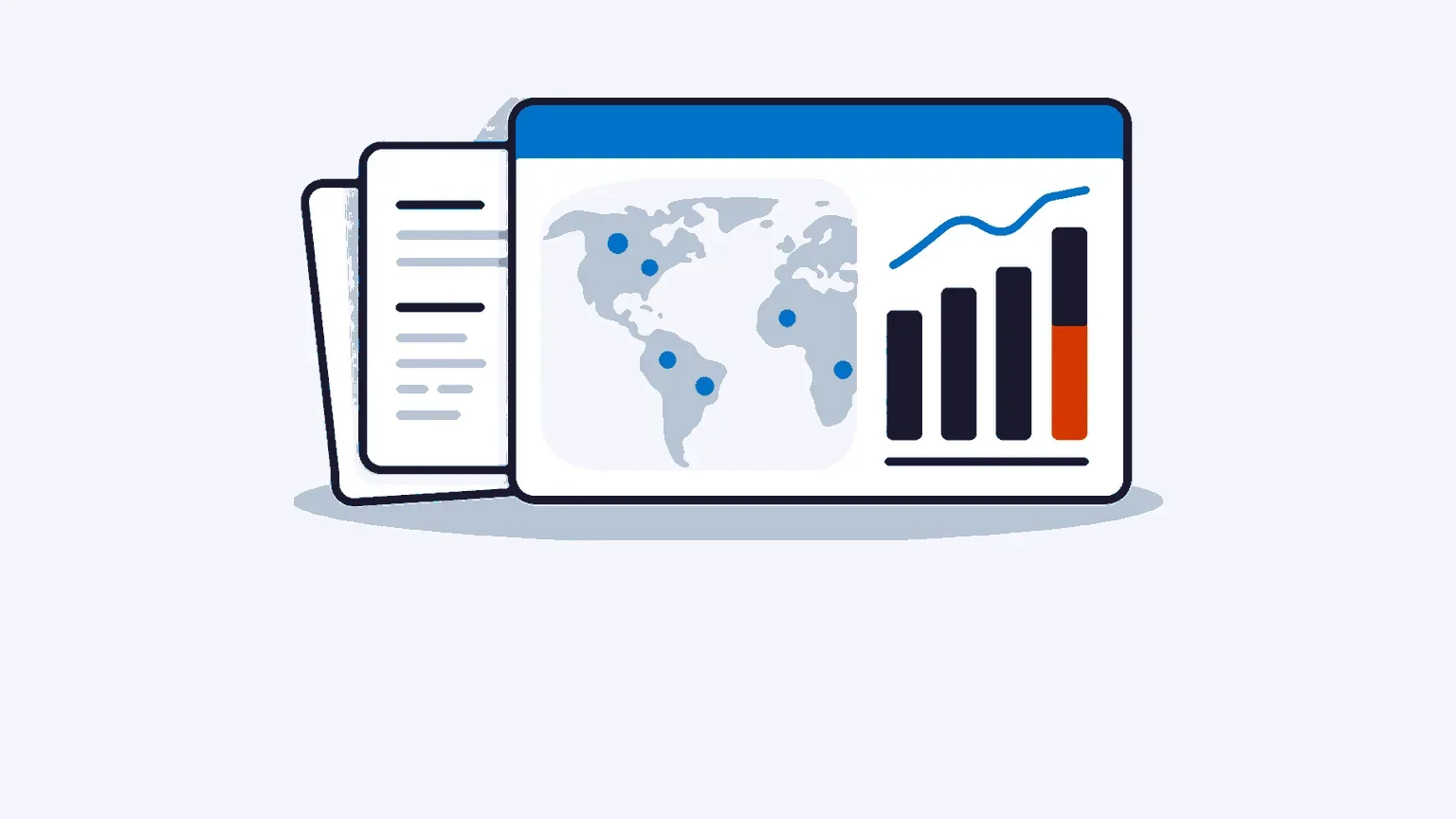
An email platform has no idea where your recipient is. It works it out. Every campaign carries a tiny image, the tracking pixel, hosted on the sender’s server. When the mail client displays the message, it downloads that image, and the request leaves a trail: the time, the email software and, above all, the IP address of the machine that asked for it.
The platform then checks that address against a geolocation database. Commercial databases, such as those from MaxMind or IP2Location, map ranges of addresses to a country, a region and a city, drawing on what network operators declare and on measurements taken in the field. The result then feeds into your statistics, as a map or a table broken down by country.
The mechanism is simple. Its accuracy is another matter. MaxMind, one of the most widely used providers, publishes its own estimates on its page about geolocation accuracy: 99.8% correct at country level, around 80% at state or region level, and 66% for the city within a 50 km radius. Those last two figures only cover addresses in the United States. So the country is reliable, the city is an educated guess, and the provider in fact attaches an accuracy radius to every result.
| Level | Reliability claimed by MaxMind | Sensible use in email marketing |
|---|---|---|
| Country | 99.8% | Segmentation, choice of language, audience breakdown |
| Region or state | around 80% (United States) | Trends by area, time zone |
| City, 50 km radius | 66% (United States) | A hint, never a decision |
That still assumes the IP address you see belongs to the recipient. This is where things go wrong.
What the map does not show you
Four things get in between your recipient and the pixel. None of them is unusual.
Apple Mail Privacy Protection hides the IP address
Since iOS 15, in September 2021, Apple has offered its users a way to protect their activity in Mail. Its documentation leaves no room for doubt: the IP address is hidden from senders, and Mail downloads remote content in the background when the message arrives. The pixel therefore loads from Apple’s infrastructure, whether or not the person reads the email. The open is not really an open, and the location that comes with it tells you nothing about where your contact actually is.
The effect is considerable. According to Litmus’s figures for July 2026, based on more than a billion opens, Apple accounts for 62.26% of opens, and Litmus points out that this figure includes opens affected by privacy protection. These numbers cover every type of audience and lean towards consumers, whereas Outlook carries more weight in B2B. Even on a business list, though, some of your geolocated opens come from Apple’s servers rather than from your prospects. Our guide to the email open rate explains what this protection does to the metric itself.
The Gmail image proxy
Gmail got there well before Apple. In December 2013, Google announced that images in emails would from then on be served through its own servers rather than from the original host. When a Gmail user opens your message, the request for the pixel therefore comes from a Google address. The platform does record an open, but it places the reader in a Google data centre, often on the other side of the Atlantic.
Your map shows a surprising number of opens in California for a campaign sent to SMEs in Brittany? Look no further.
VPNs, mobile networks and corporate gateways
A recipient connected through a VPN shows up at the location of the VPN server. MaxMind says so plainly: in that case it can locate the server, not the end user. The same goes for mobile networks, whose addresses are shared by phones spread over long distances, to the point that MaxMind simply stops providing a city.
B2B adds a case all of its own. Many groups route their employees’ internet traffic through a central gateway, at head office or with a security provider. Your contact at the Lyon office will appear in Paris, or even in another country. That does not make the data wrong: it locates the company’s network, not the person.
Security filters that open emails on the recipient’s behalf
The last intruder, and the most specific to B2B, is the security gateway of business mailboxes. Microsoft Defender for Office 365, for example, scans the links in incoming emails while they are in transit, before the message is even delivered. Other products on the market inspect links and images in the same way. These checks trigger opens and clicks that nobody made, from the security provider’s addresses.
They have a recognisable signature. An open a few seconds after sending, several links clicked within the same second, an IP address belonging to a hosting company rather than an internet service provider. On a list of key accounts, these machines can draw a good part of the map.
Timing your sends to your recipients’ time zones
For all its limits, geolocation is genuinely useful once your list spans more than one time zone. A campaign that goes out at 9 am Paris time lands at 3 am in Montreal and 4 pm in Singapore. For a software publisher selling in Europe, North America and Asia, the gap eventually shows in the clicks.
Even so, do not leave that decision to the open IP alone. Cross-check it with what you already know about your contacts: the country entered on the form, the phone dialling code, the company address in your CRM. Geolocation then works as a check. If your “Canada” segment mostly opens from France, your contacts may be subsidiaries run from Paris, and the send time should follow suit.
On the French market alone, the benefit drops sharply: mainland France lives on a single time zone. That leaves the French overseas departments and regions, and this is exactly where the open map earns its keep, picking them out when your list does not.
Segmenting by area without relying on the IP address alone
The country of the open is solid enough to build segments on, provided you first strip out the noise. Three habits are enough.
- Exclude machine opens before reading anything geographical: Apple’s preloading, the Gmail proxy, security bots. Without that sorting, your top countries will be wherever the data centres are.
- Think in clicks rather than opens. A human click that lands on your site produces a visit that your web analytics tool locates with its own rules, and you can compare that with the open map.
- Work with trends, not individual contacts. A rise in opens in Belgium over three campaigns tells you something. A single open in Geneva tells you nothing at all.
Used properly, this reading answers practical questions. Do you need a version of the newsletter for French-speaking Switzerland? Did your trade show in Lyon stir up interest across the Auvergne-Rhône-Alpes region? Are your sales reps covering the areas where interest is showing? It sits alongside the B2B email marketing KPIs that steer your business, without replacing them.
What you should avoid is an alert sent to a sales rep saying “this prospect has just opened your email in Marseille”. Too often, Marseille will turn out to be a server belonging to Apple, Google or a security filter.
What the GDPR says about open geolocation
An IP address is anything but harmless. In its Breyer judgment of 19 October 2016 (C-582/14), the Court of Justice of the European Union ruled that an IP address, even a dynamic one, can be personal data for anyone who has lawful means of identifying the person using it. The location derived from it logically follows the same path.
The CNIL, the French data protection authority, has set out the rules that apply specifically to email. Its recommendation on tracking pixels, published on 14 April 2026, makes consent a requirement for measuring opens individually for performance or personalisation purposes. Geolocation tied to a named contact falls within that framework. For recipients who have not consented, you are left with aggregated, anonymous measurement: a breakdown of the campaign by country, with no link to any individual. We have covered what changes in our article on the CNIL’s tracking pixel recommendation.
For most of the uses described above, aggregate data is more than enough. Choosing a send time for each area or launching a local version of your newsletter does not require knowing that Mr Dupont reads his email in Nantes.
What the Ediware platform shows you, and what no tool can show
In Ediware, open geolocation is part of the statistics for every campaign, alongside opens, clicks, bounces (hard and soft) and unsubscribes. Two features make the map easier to read. Automated interaction filtering, which you can switch on campaign by campaign, discards any open or click that occurs within six seconds of delivery, along with those coming from known bot IP addresses and host names. The breakdown by mailbox provider, for its part, shows how much weight Gmail, Microsoft or Orange carries in your results, so you know what share of the map goes through a proxy. Ediware’s campaign statistics and reporting bring these views together in a single dashboard.
What no platform will ever do, on the other hand, is find the real city of a protected Apple Mail user or of an employee behind their group’s gateway. The information simply is not in the request. Be wary of any tool that displays a map down to the neighbourhood without saying a word about its limits: what it mostly shows you is data centres.
Open geolocation therefore remains supporting data. Useful for understanding where your audience is, setting your send times and spotting an area that is waking up. Misleading as soon as you ask it to track an individual.
Related articles
Email unsubscribe rate: understanding and optimising it
Benchmarks put the email unsubscribe rate between 0.12% and 0.22%. Above 0.5%, your segmentation or your sending frequency deserves a closer look.
10 min read B2B email marketingB2B landing page A/B testing: why the classic method fails
Classic A/B testing needs at least 100 conversions per variant to be reliable. Most B2B campaigns never reach that volume. Here is what to do instead.
6 min read B2B email marketingEmail marketing statistics: key figures by sector
376 billion emails a day, a €36 return for every €1 spent (DMA) and a 33.9% average open rate in France: the key email marketing figures by sector.
8 min read Email marketing tipsEmail open rate: the complete guide to measure and improve
Email open rate: French benchmarks by sector, the impact of Apple MPP, 7 best practices and complementary KPIs. Data from EmailScope.fr and DMA France.
12 min read