
Home›B2B email marketing›Personalisation with AI
Using AI to personalise your B2B email campaigns
On this page
On this page
- Four levels of personalisation, and where AI comes in
- Personalisation starts in the file, not in the prompt
- Write the variants upfront, not at send time
- Segmenting with AI without handing over the keys
- How far to personalise without becoming intrusive
- The legal framework: GDPR, profiling and the AI Act
- Measuring with a control group
- In the sending platform, in practice
In brief: AI does not personalise anything on its own. It cleans up your fields, drafts one variant per segment and prepares an opening line for each account, provided the file is clean and every text gets read by a person. The rest comes down to GDPR and a control group.
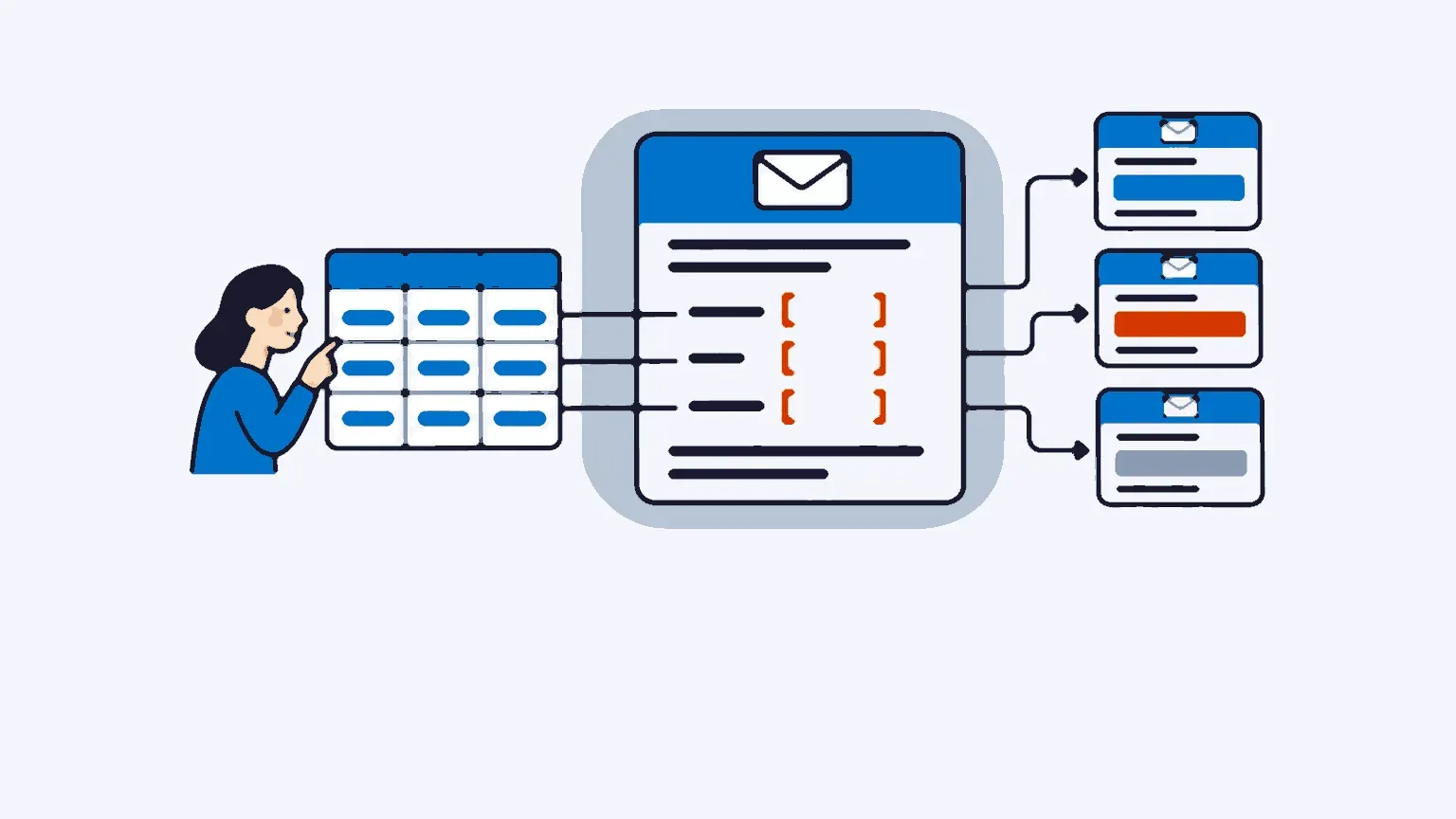
According to the French edition of Salesforce’s State of Marketing report, published in March 2026, 71% of marketers have adopted AI. The same report finds that 81% of them still send one-size-fits-all campaigns, and that 77% are expected to produce more personalised content than they can actually deliver. The tool is in place; the campaigns are still the same for everyone.
There is nothing mysterious about the gap. Teams plugged AI into copywriting, not into personalisation, and those are two separate jobs. Writing an email faster tells you nothing about who should get it, with which argument, or on the strength of which piece of data. This article starts with the file and ends with measurement, stopping on the awkward parts along the way: bad data, personalisation that makes people uneasy, and the legal framework. It builds on our guide to B2B email marketing, which sets out the overall strategy.
Four levels of personalisation, and where AI comes in
A lot gets filed under “personalisation”. A first name in the subject line is one kind. A paragraph written for a single prospect is another, and it has very little in common with the first, whether in effort or in risk.
| Level | What changes from one recipient to the next | Data required | Where AI is useful |
|---|---|---|---|
| Variable | First name, company, signing salesperson, reply-to address | The columns in your file | Cleaning and standardising fields before import |
| Block per segment | A paragraph, an image or a link depending on sector or job function | A reliable segmentation field | Drafting one variant per segment |
| Behavioural segment | Which message is sent, based on clicks and visits | Campaign history | Suggesting groupings, spotting active contacts |
| Individual text | An opening line specific to each account | A verified record for each prospect | Drafting a first version, to be checked one by one |
Read from top to bottom, the table says something simple. The further down you go, the more work AI has to do, and the better your data needs to be. At the first level, a mistake shows “Hello ,”; at the fourth, it invents a project your prospect never had.
Most B2B teams get more out of mastering the first two levels than out of jumping straight to the fourth. It is less impressive, and far more profitable per hour spent.
Personalisation starts in the file, not in the prompt
A language model does not fix a faulty contact database. It formats it. If your “Company” column contains “DUPONT & SONS LTD”, “dupont and sons” and “Dupont”, it will produce three emails that sound different for the same business.
The problem goes well beyond your own file. In its State of CRM Data 2026 report, Validity notes that only 21% of the marketers surveyed consider their CRM data very well prepared for their AI tools, while 62% believe bad data has probably cost them revenue. The survey covers 500 marketers outside France, but the picture will look familiar to anyone who has ever opened a CRM export.
This is where AI does its first useful job, quiet and underrated. Before any campaign, it can:
- put company names back into normal case and strip out legal suffixes;
- spot a first name sitting in the surname column, or a title that does not match;
- sort free-text job titles (“Purch. mgr”, “Senior buyer”, “Procurement”) into a handful of usable functions;
- flag the rows too incomplete to personalise.
Check every correction on a sample before applying it to the whole file. And for the gaps that remain, set a default value: “your company” always beats a blank in the middle of a sentence.
Write the variants upfront, not at send time
There are two ways of going about it. The first has AI generate the text at send time, contact by contact. The second has it write the variants in advance, gets them reviewed, then inserts them through variables. In B2B, the second almost always wins, for a very down-to-earth reason: you know what is going out.
Take a campaign aimed at three sectors and two job functions. That makes six variants of the core paragraph. AI drafts them in a few minutes from a shared brief, someone reviews them in twenty, and each recipient gets the paragraph for their box. The test send shows exactly what a finance director in manufacturing will see, and what a marketing manager at a consultancy will see.
The same logic applies at the fourth level. For an account-based campaign of 50 to 200 companies, AI can suggest an opening line per account from a record you have filled in: public news, a known project, a reason to get in touch now. That line goes into a column of the file, someone approves it, and it is then pulled into the email like any other variable. Nothing is made up at the last minute, and every text has had a reader before the recipient.
What do you give up? “Live” generation across thousands of contacts. For a prospecting campaign, that is no loss. A plausible but false sentence sent to a decision-maker costs more than an accurate sector paragraph.
Segmenting with AI without handing over the keys
The third level relies on behaviour: who clicked on what, who has not opened anything in six months, who keeps coming back to the pricing page. AI is good at finding groups in that data, and in B2B predictive segmentation is mostly useful for one thing: deciding who to follow up first, and who to leave alone for a while.
There is, however, a limit specific to B2B to keep in mind. Volumes are small. A segment of 40 contacts proves nothing, however elegant the algorithm that built it. A readable rule, such as “clicked twice in three months on technical content”, is often worth more than a grouping nobody can explain. You can check it, discuss it with the sales team and correct it.
For everything else, our article on AI for B2B email marketing covers lead scoring and send-time optimisation, so there is no need to go over them again here.
How far to personalise without becoming intrusive
Some personalisation drives people away. Gartner measured it in a survey of 1,464 B2B buyers and consumers published in June 2025: badly placed personalisation at decision points makes buyers 3.2 times more likely to regret their purchase and 44% less likely to come back. On the consumer side in France, the customer relations observatory run by Notify, reported by Siècle Digital in July 2026, found that a majority of people feel uncomfortable with AI-targeted messages.
B2B has its own version of the problem. The email that comments on your prospect’s latest LinkedIn post, congratulates their company on a funding round from 2021 and guesses they are “probably rethinking their email tool”. None of it is false, and all of it reads like automated surveillance.
A few rules hold up well in practice:
- start from what the contact has given you or from what relates to their professional activity;
- never show an inference: “you are probably working on…” becomes “the procurement teams we talk to are working on…”;
- one piece of information specific to the recipient per email is enough; two start to show;
- if you could not tell the prospect where the information came from, take it out.
The legal framework: GDPR, profiling and the AI Act
Personalisation runs on personal data, even in B2B, and the rules do not change because an AI is the one using it. The CNIL, the French data protection authority, accepts B2B email prospecting on the basis of legitimate interest, provided the subject of the message relates to the person’s profession. For data obtained from a third party, you need to make sure the person has been informed.
Profiling has its own article in the GDPR. Article 21 gives everyone the right to object at any time to the processing of their data for direct marketing, “including profiling to the extent that it is related to such direct marketing”. In practice, an unsubscribe must also take the contact out of your behavioural segments, not just off the mailing list. Article 22, which covers automated decisions with legal or similarly significant effects, does not in principle apply to choosing which paragraph goes into an email; it becomes relevant again if your scoring is used to exclude companies from an offer.
One practical question remains, and many teams forget it. Pasting a prospect file into a consumer AI assistant means passing personal data to a third party, often outside the European Union. Work on pseudonymised data, or with a tool whose hosting you know.
And the AI Act? Its transparency obligations, under Article 50, have applied since 2 August 2026. As the text stands, they cover systems that interact with the public, the labelling of synthetic content by providers, and texts published to inform the public on matters of public interest. A commercial email reviewed by a person does not appear to be in scope. Some caution all the same: the Commission’s guidelines may still clarify the point.
Measuring with a control group
Without measurement, personalisation remains a belief. In Litmus’s State of Email 2025, 15% of marketers name measuring its impact among their challenges.
The most reliable method is also the oldest: the control group. You randomly set aside part of your audience, 15 to 20%, which receives the standard version. Everyone else gets the personalised one. Same day, same time, same subject line if it is the body you are testing.
When you compare, forget the open rate. Since Apple’s Mail Privacy Protection, some opens are recorded automatically, and the difference you see may owe nothing to your copy. Look at clicks, replies and, for prospecting, meetings booked. On a small file, combine two or three campaigns before drawing conclusions: a handful of replies’ difference on 300 sends settles nothing.
The control group has another merit. It puts a figure on the time spent. If six reviewed variants bring in three extra meetings on a campaign, you know what an hour of work is worth, and you know where to stop.
In the sending platform, in practice
Once the data is clean and the variants reviewed, the work ends in the sending platform. In Ediware, variables can go in the message body, the subject line, the sender name and the reply-to address: each prospect can receive the email from their own account manager and reply to them directly. They also work in links and image URLs, so you can show a different visual or page depending on the sector. An imported file carries up to 26 personalisation columns, a hosted list has no limit, and every variable accepts a default value for empty fields.
The AI built into the platform works upstream of the send: it writes or rewords content in your template, proofreads it, and translates a campaign into English, German or Spanish. The data stays hosted in France, which settles the question of the file pasted into a third-party tool.
So personalisation with AI owes less to magic than to method. A clean file, a few well-written variants, a segmentation rule you can explain, and a control group to settle the matter. That is what stops a campaign from being the same for everyone.
Related articles
Writing B2B emails with AI without losing your voice
Write B2B emails with AI without sounding like everyone else: what to delegate, a voice sheet, the tics to avoid in French and a six-question review.
10 min read B2B email marketingEmail provider market share in France (2025-2026)
No official study sets email provider market share in France, but the trends are clear: Gmail and Microsoft lead, ISP webmails decline, B2B has two suites.
9 min read B2B email marketingChatGPT for writing B2B emails: method, prompts and pitfalls
ChatGPT writes fast, but rarely gets it right first time. Everything hinges on the prompt and the proofreading. Here is the method for reliable B2B emails.
9 min read B2B email marketingWill AI replace email marketing copywriters?
AI speeds up email production, optimises subject lines and personalises at scale, but strategy, brand tone and empathy still belong to the copywriter.
8 min read