In a nutshell
Emailing refers to the grouped sending of emails to a list of recipients for commercial or marketing purposes. The most profitable channel in digital marketing, with an average ROI of €36 for €1 invested, it remains a must for both B2B and B2C. Its success relies on a qualified base, relevant content, good deliverability and compliance with RGPD.
Introduction
Every day, billions of business e-mails are exchanged around the world. Order confirmations, newsletters, promotional offers, sales reminders. Email has been present in every employee’s inbox for over 20 years. And despite claims of its periodic demise, it’s not about to disappear – quite the contrary.
Every day, billions of business e-mails are exchanged around the world. Order confirmations, newsletters, promotional offers, sales reminders. Email has been present in every employee’s inbox for over 20 years. And despite claims of its periodic demise, it’s not about to disappear – quite the contrary.
Email remains the marketing communications channel that generates the highest returns for the lowest cost. This is proven every year by case studies: for every €1 spent, a well-crafted email campaign yields an average return of €36 (source: Statista). No other marketing lever can match this level of performance.
But what does emailing really mean? What are the different types of email campaigns? What are the best practices to adopt and the results you can expect? These are just some of the questions we’re going to try and answer. We’ll start by looking at what differentiates email marketing from other forms of digital communication, the best practices to follow if you want your email campaigns to succeed, and the main KPIs that every marketer needs to track in order to measure campaign performance.
Email remains the marketing communications channel that generates the highest returns for the lowest cost. This is proven every year by case studies: for every €1 spent, a well-crafted email campaign yields an average return of €36. No other marketing lever can match this level of performance.
But what does emailing really mean? What are the different types of current email campaigns? What are the best practices to adopt and the results you can expect? These are just some of the questions we’re going to try and answer. We’ll start by looking at what differentiates email marketing from other forms of digital communication, the best practices to follow if you want your email campaigns to succeed, and the main KPIs that every marketer needs to track in order to measure campaign performance.
Definition of emailing
Emailing consists of sending a single email to a group of recipients. It’s also known as email marketing or email campaign. The concept is simple: instead of writing an e-mail to a single person, you send the same message to several hundreds, thousands or even millions of contacts in just a few clicks.
At first glance, this may seem obvious. However, email marketing should not be confused with the individual email you send to a colleague or customer. An individual e-mail is a message that can be described as conversational or one-to-one. Emailing is a mass mailing that goes through a dedicated platform that orchestrates the sending, tracks statistics and makes sure that everything is done in accordance with the law.
And then, if you say to yourself “Well, why don’t I try sending an e-mail campaign via Outlook or Gmail? “and send a blind copy to 50, 100 or 300 people, that’s simply not a good idea. Mail services don’t like this kind of practice and will penalize you very quickly. Not to mention the fact that you won’t know whether your recipients have opened your message, clicked on any of the links contained in the e-mail, etc.
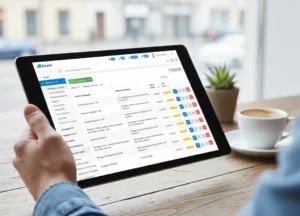
Why use an emailing platform? Because it provides you with additional tools for building your contact base, as well as enabling you to write your messages in HTML, personalize your content according to target, program your campaigns, and above all, track your statistics. Open rates, click-through rates, unsubscribe rates… all figures that will enable you to make progress over time.
Today, emailing is used in two main contexts. In B2C, brands use it to send emails to their customers: promotional offers, newsletters, loyalty programs… In B2B, emailing has become one of the most effective prospecting & nurturing techniques. Professionals consult their mailboxes several times a day. This means that a well-targeted e-mail, with content of high perceived value, has a high chance of being read.
The different types of emailing
There are many different types of email marketing. Depending on the purpose, the format, content and frequency of sending can be very different. Here are the main types you’ll come across.
Newsletter
Newsletters are undoubtedly the best-known form of emailing. Its purpose: to maintain a relationship with an audience, to inform them and build their loyalty. For example, a company that regularly publishes content on its blog could send out a monthly newsletter to relay the articles it has written during the month. An e-tailer could use this channel to highlight new products or product uses.
The newsletter is characterized above all by its regularity. It can be weekly, fortnightly or monthly, creating an appointment with its reader. To date, the content rarely contains commercial information. It’s often a question of informing and/or educating, adding value and positioning the magazine as an expert on a given topic. It’s not about making an immediate sale, but rather about helping to create a need/further the potential buyer’s thinking.
In BtoB, the newsletter is an excellent vehicle for disseminating content such as case studies, feedback and industry news. Professionals tend to appreciate any content that enables them to learn and/or progress in their field of activity.
Prospecting emails
This email has a 100% commercial objective. The primary aim of prospecting emails is to generate incoming requests, and therefore sales. The aim is to contact prospects who don’t know us yet, or who don’t know us very well, to present them with an offer that might interest them.
In BtoB, this type of email is subject to strict rules by the RGPD, but remains authorized under certain conditions. It’s perfectly possible to contact people for whom the offer you’re proposing is of interest, and to do so without having asked for their prior consent. For example, an accounting software publisher can canvass chartered accountants. On the other hand, he wouldn’t hurt these financial professionals by offering them a sports coaching program.
This type of mail works in BtoB. At Ediware, we see this every day with our customers. But it can’t be improvised. It requires upstream work: precise targeting, a message adapted to the target, and a clear sales argument. Sending a generic e-mail to a randomly purchased list of contacts is guaranteed to make the recipients hate you, and to ruin your reputation as a sender.
Promotional email
The aim of a promotional email is to directly trigger a sale. Private sales, sales, promotional offers such as “10% off your 1st order”, Christmas operations, Black Friday, Mother’s Day… You’ll see a whole host of offers sold through hard-hitting copywriting in “2 clicks 3€ Free Delivery” ” + call-to-action button to buy here! to take advantage of the offer!” … etc.
While it’s easy to believe that this form of email marketing is effective, it has to be used very sparingly. If you bombard your contacts daily with promotional campaigns, they’re bound to end up hating you. Their open rate will plummet and unsubscribe rates to your mailing lists will soar. It’s best to reserve these campaigns for dedicated times of the year (Mother’s Day, Black Friday, Christmas, product launches, end of stock,…) / Season and juxtaposed with a little value-added content!
Timing is another parameter not to be overlooked. A promotional campaign launched at the right time, to a contact who has recently shown an interest in your offer, will yield far more effective results than a campaign sent in haste, to an unsegmented base.
Transactional email
Transactional email has a special place. It doesn’t really fit into the “marketing” box in the strict sense of the word, but it’s inseparable from customer relations. This refers to all emails that are sent automatically following an action by the web user: order validation, delivery notification, password reset, invoice.
In most cases, these emails have exceptional open rates, often in excess of 80%. Normal: the recipient expects them. And yet, this is a target that we often tend to forget. An order confirmation may contain product recommendations in the footer. A delivery notice may end with a “Follow us on social networks”.
Sometimes it’s hard to draw the line between transactional email and marketing email. The key is to ensure that the promotional aspect does not take precedence over the information the recipient is looking for.
The follow-up email
The last type of email concerns reactivation. Over time, part of your contact base becomes inactive. People who, at one time, opened and responded to your emails, others who never completed their purchase journey after filling their shopping cart.
The follow-up email will try to rekindle the flame with these contacts. For inactive customers, you can send them an e-mail like “We miss you” with a promotional code to motivate them to come back. For abandoned shopping baskets, a reminder a few hours after abandonment, why not with a promotional code, is sometimes enough to trigger an order.
These automated emails, sent in response to contact actions, are among the most profitable marketing automation scenarios. They are aimed at people who have already expressed some form of interest. Half the work is already done.
Why should companies turn to emailing?
Despite the growing number of communication channels, emailing remains a popular lever for marketers for many reasons. Here’s a closer look.
Profitability among the best on the market
What does this mean in figures? According to studies by the Data and Marketing Association (DMA), email marketing has to be one of the most efficient, generating €38 in sales per euro invested. All this at an extremely low cost.
Sending an e-mail costs only a few cents or even less per hour. And it’s well-targeted, since recipients have either given their consent to receive your emails, or are a perfect match for your target. Email marketing is also highly personalizable, which boosts conversion rates.
In B2B, the feeling is the same. According to the e-router studies published each year by the DMA France, the email channel is still considered the most strategic by 91% of marketers, ahead of social networks at 83%.
A 100% controlled, 100% measurable channel
This is perhaps the biggest forgotten benefit of email marketing. If you work your audience on Facebook, Instagram or LinkedIn, you never own it. These platforms can change their algorithms overnight, reduce the organic reach of your publications, or even close your account. You’re at the mercy of their decisions.
With email, it’s different. Your contact list belongs to you, it’s part of your company’s heritage, just like your customer base in your CRM. No one can take it away from you, and no one can decide for you who will see your e-mails.
The other advantage is measurability. Each campaign enables us to collect a whole host of statistics: How many e-mailings were opened? How many recipients clicked? Which links were clicked? How many unsubscribes? etc. All this information enables you to measure what’s working (or not) and to look for ways to improve your results. Try to obtain the same level of detail for a poster campaign or a radio spot.
Ultra-affordable rates
Compared to other acquisition channels, email marketing is still very affordable. You don’t need to spend several thousand euros to get started. A small company can start campaigns for just a few hundred euros a year, platform included.
The business model for email marketing tools oscillates between a monthly subscription fee that depends on the size of the base, and a no-obligation credit system like Ediware. You pay for what you use, without a subscription that runs even when you’re not sending anything.
One of the reasons why emailing is often the first digital lever for small and medium-sized businesses? The entry ticket is very low, and the results visible very quickly. You can start small and build up as you go along.
How to run a successful email campaign?
Having an emailing platform isn’t enough. You need to know how to use it. Here are the basics you need to master to get results.
Build a qualified contact base
It all starts with the database. No recipients, no campaign. But beware: quantity isn’t everything. Better 1,000 well-targeted contacts than 50,000 randomly selected addresses.
In B2C, it’s simple: the person must give their explicit consent before you send them commercial emails. We call this opt-in. A registration form on your site, a box to tick when making a purchase… The contact must have taken a voluntary step.
In B2B, it’s a little different. The RGPD authorizes email prospecting to professionals without prior consent provided that the message is related to their business. This is known as legitimate interest. A medical equipment supplier can target doctors. A management software publisher can canvass CFOs.
But in any case, avoid buying e-mail databases from disreputable service providers. These files often contain partially obsolete addresses, spam traps or even contacts that never existed. The result: your reputation as a sender takes a hit, and your e-mails end up as spam, including those you send to your real customers.
In B2B, databases like DataProspects provide access to qualified contacts, which we update regularly, and which are RGPD-compliant. It’s a budget… but it’s the guarantee of working with reliable data.
Working on the object and preheader
The subject line is the first thing an e-mail recipient sees. In fractions of a second, they decide whether or not to read it. It’s at this moment that everything is decided.
The subject line should be short. Aim for a maximum of 50 characters so that it can be read in its entirety on a cell phone. It should make people want to know more… without saying everything. Avoid formulations that are too commercial, such as UPDATE, TOO MANY!!!!, exclamation marks, etc., all of which send signals to the filters. All the signals that make spam filters go into overdrive and exasperate recipients.
The preheader is the text that appears right next to the subject in the email list. On mobile, it’s often there before the email is even opened. Many marketers neglect it, even though it represents a 2nd chance to hook the recipient. Use it to complete the subject line… but not to repeat the same thing.
Test several versions. Emailing platforms allow A/B testing. Here’s how it works: you send 2 versions of the subject line to a sample of your database… then you choose whether to send everyone #1 or #2, depending on which has the best open rate.
Creating relevant, responsive content
Once the email has been opened, it’s time to remember. The content must meet the reader’s expectations. Something that interests them, informs them usefully, moves them forward, etc.
When it comes to content, it’s as much the content as the form that counts. On cell phones, emails that are too long… discourage reading. Get to the point. A clear hook, a visible call-to-action. Do you have a lot to say? Make several mailings, but don’t dilute them.
The design must be responsive, i.e. it must be able to adapt automatically to the size of the screen. More than half of all emails are now read on smartphones. If your message doesn’t display well on a mobile, it often ends up in the garbage can. Email marketing software like Ediware’s already offers you responsive templates, so there’s no need to spend hours looking for the perfect layout.
Also consider the balance between text and images. An all-image email would be fraught with problems. Some e-mail clients don’t display images by default. Spam filters don’t trust emails that have no text at all. What’s more, if the images don’t load, the message is simply unreadable.
Complying with the law (RGPD)
The RGPD very strictly frames the way personal data is collected and used, and that includes email addresses. And if you don’t comply with the rules, it can be very costly. So it’s best to be informed.
In B2C, you absolutely need the consent of the person before sending them commercial emails. And this consent needs to be more than just a box quickly ticked. It must be free, specific, informed and unambiguous. And you need to be able to prove that the contact has given you permission to solicit them.
In B2B, you can send prospecting e-mails without prior consent if you have a legitimate interest in doing so… but within certain clearly defined limits. The offer must correspond to the prospection activity of the person you are addressing. Every e-mail must include a link to unsubscribe. And data must not be kept indefinitely.
In any case, each email must allow the recipient to unsubscribe easily and simply. One click, without having to justify it. Sending platforms automatically manage unsubscribes and clean up the contact list.
Working on deliverability
Deliverability is the ability to ensure that your e-mails actually reach the recipients’ inboxes. Because between the moment you click “send” and the moment your message is read, a lot can go wrong. Spam filters, blocking by e-mail providers, invalid addresses…
First point: technical authentication. The SPF, DKIM and DMARC protocols enable mail servers to verify that you are who you say you are, and that you have the right to send these e-mails. If you haven’t set this up, many will treat you as spam. Serious platforms do it automatically.
Second point: the sender’s reputation. Internet service providers such as Orange, e-mail services such as Gmail or Yahoo, assign a rating to each sender based on its history. Too many complaints, too many emails sent to addresses that don’t exist, and that rating plummets. Your emails end up in the spam box.
Third point: the quality of your database. Addresses that no longer exist, spam traps and contacts who haven’t opened one of your e-mails in years are never good for your sending statistics, and even less so for your reputation. So you need to clean up your database regularly. Tools like CleanMyList.email can help. They allow you to check that addresses are valid before sending them, and also to identify at-risk contacts.
Key indicators to track
One of the many advantages of email marketing is its amazing ability to measure everything.
Each campaign generates a wealth of data that can be used to analyze results and assess areas for improvement. It’s just a question of knowing what to look at!
Open rate
The open rate indicates the percentage of recipients who have opened your e-mail. For example, if you send out 1,000 e-mailings and 200 recipients open the e-mails received, your open rate is 20%. This is the most closely monitored metric, and often the first one we look at.
This rate largely reflects the quality of your subject and the trust/curiosity in your brand. A sender known to the recipient and a striking or intriguing subject generate opens. An unknown sender associated with a random subject generally goes unnoticed.
Averages vary from sector to sector. In B2B, an open rate of between 15% and 25% corresponds to acceptable performance. High-value newsletters can exceed 30%. Cold-prospecting e-mailings tend to hover around 10-15%. And here’s an important point: since 2021, openers on Apple email clients and other privacy-protecting solutions have had an impact on open rates. As a result, you may see open rates throughout the day, even though you haven’t necessarily sent any campaigns that day. The open rate is still relevant for comparing your different campaigns, but you now need a policeman with it.
Click-through rate
The click-through rate indicates the percentage of recipients who clicked at least once on one of the links in your e-mail. It’s a more reliable metric than the open rate, because it shows real commitment. In fact, anyone who clicks has not only opened the e-mail, but also found the content interesting enough to go further.
We can sometimes distinguish between the overall click rate, calculated on all recipients, and the reactivity rate, calculated only on openers. This latter indicator is used to assess content quality, independently of the object’s performance.
In B2B, a click-through rate of between 2% and 5% is normal. This rate depends very much on the nature of the message and the visibility of your call to action. The clearer and more visible your button, the more clicks you’ll get. An e-mail with a single, well-developed link will generally get more clicks than one with 10 scattered links.
Conversion rates
The conversion rate goes beyond the simple click. It will indicate the percentage of recipients who have carried out the expected action(s) following consultation of the page to which they were redirected after the click. The expected action may be a purchase, a quote request, a webinar registration, a document download…
This metric requires further traceability. You need to be able to link the click in the e-mail with the actual action taken on the website. Emailing platforms generally automate this by adding tracking parameters to URLs. Conversions can then be tracked in Google Analytics or other analysis tools.
The conversion rate is the indicator that will show the real return on investment of your action. Indeed, an e-mail may have a very good open and click rate, but if it doesn’t generate any conversions, then it’s legitimate to think that its only purpose was to serve a purpose.
Bounce rate and unsubscribe rate
Bounces are e-mails that could not be delivered. A distinction is made between “hard” bounces, caused by an invalid or non-existent e-mail address, and “soft” bounces, caused by a full mailbox or a momentarily unavailable server.
A high bounce rate is one of the alarm signals. Above 2-3%, the quality of your database is a problem. ISPs monitor this rate. Too many bounces and they start blocking your mailings.
The unsubscribe rate corresponds to the proportion of people who unsubscribe after receiving an e-mail. An unsubscribe rate of less than 0.5% is satisfactory. Anything higher and something is wrong. Either you’re sending too often, or the content doesn’t match expectations, or the base wasn’t qualified in the first place.
These two metrics are important to monitor, especially as they impact your reputation as a sender and therefore your future deliverability.
Emailing and marketing automation
So far, we’ve mainly been talking about single campaigns. You decide to launch a campaign, you create it, you program it, it goes out. But emailing can also be an automatic process, with no need for you to be prompted each time a campaign is sent.
Marketing automation is the ability to send emails automatically, based on the recipient’s situation or profile. Someone downloads a white paper from your site? They automatically receive a thank-you email, followed by a series of emails on the same subject. A prospect hasn’t opened your last 3 emails? A reactivation scenario is automatically triggered. A customer hasn’t ordered in 6 months? We’ll automatically send him an offer to reactivate him…
These scenarios, once set up, run non-stop. They work for you 24/7. The time saved is enormous, especially if you’re part of a small marketing team, and can’t do everything by hand.
The other advantage is that it’s ultra-relevant. An email sent automatically following a specific action is usually the right moment. The contact has just become interested in what you have to offer, and is receptive. It’s far more powerful than a mass mailing you might have thought of on a Tuesday morning…
There are plenty of scenarios that are the most basic, and very easy to set up. The welcome email, which is sent automatically following registration. The nurturing sequence, which allows you to support a prospect in his or her reflection phase with “educational” content. Abandoned cart follow-up for e-tailers. Birthday emails with personalized discounts.
There are more advanced scenarios that take things a step further. We can connect a scoring system that will take into account the contact’s engagement, then depending on the level of interest, either send sales proposals to warm prospects, or continue to send content to lukewarm prospects. And all this without the need for a salesperson to intervene.
At Ediware, our solution not only allows you to build these automatic reminder scenarios, but also to link them to other tools thanks to Zapier. We can connect over 1,000 applications to automate processes ranging from contact forms to synchronization with your CRM.
Why choose a French emailing platform?
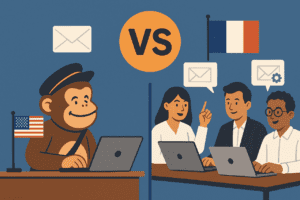
The market for emailing platforms is far from saturated. American solutions such as Mailchimp, or European alternatives, share a good part of the market. And yet, choosing a made-in-France solution means real advantages, which many companies tend to underestimate.
First reason: proximity and quality of support. It’s Monday evening, and you’ve got a bug sending out your newsletter. Would you rather go through the headache of trying to make sense of it all with a robot / an unpleasant English-speaking support person? Or can we help you out in the language of Molière? With international platforms, you’re often offered help… by chat, by email, in English, within a timeframe that varies, and often boils down to “we’ll get back to you by email…”. At Ediware, it’s included in the subscription, it’s telephone troubleshooting with a real person… and it’s free!
Second reason: data. The RGPD is good, but it shouldn’t be a brake on your business and emailing strategy. Since the repeal of the Privacy Shield, transferring data outside the European Union has become more complicated. The problem is that your data… is sent to servers based in the United States. And until further notice, this country is a long way from the European Union in terms of data protection legislation. And then there’s the other reality: many of your recipients are indeed based in Europe, and you need to be able to respect that. With a French solution, your data, stored so that you can send emails, stays with us: in France, or at worst in Europe. Compliance is in our DNA.
Third reason: the local market. B2B isn’t an exact science, and even less so in France. Between the laws, best practices and expectations of the pros, there’s no arguing that our dear marketers have one more race to win: “How do I create a B2B email campaign that works with French decision-makers? “Well, from the outset, a platform designed and conceived for the French market will integrate natively and even by default that: “The French are sensitive to beautiful templates, but like to know the truth, the tutorials are in French, and then shit the marketers are going to give something else in jupytehébergé and say it clearly and precisely”, And that’s all the details that make French marketers feel more like subscribers to an English club, please!
So, at Ediware, we’ve been on the market since 2002. More than 20 years of experience in the B2B market, one of the best technical infrastructures for sending emails (dedicated IPs and a lot of processes for you), an Ediware team 100% based in France, who love their role of supporting their customers. And let’s not forget: an ecosystem included in the subscription, including the solution where we send the emailings, a B2B database to find contacts like DataProspects, and a solution to check the email of these contacts, CleanMyList. Everything you need for successful campaigns!
Frequently asked questions
What exactly is emailing?
Emailing refers to the grouped sending of emails to a list of recipients for commercial or marketing purposes. Unlike individual emails, it requires a specialized platform to manage mailings, track statistics and comply with regulations. It’s also known as email marketing.
What’s the difference between emailing and newsletters?
The newsletter is just one type of emailing. It aims to inform and build loyalty with regular editorial content. Emailing also encompasses promotional, transactional, prospecting and follow-up emails. Each format serves a different purpose.
Will emailing still be effective in 2026?
Yes, emailing remains the digital marketing channel with the best return on investment. Studies show an average ROI of €36 for every €1 invested. Open rates remain stable despite the over-solicitation of Internet users, provided that good practices are followed.
Is it possible to conduct B2B email prospecting?
Yes, the RGPD authorizes B2B prospecting without prior consent under certain conditions. The offer must be related to the recipient’s professional activity. An unsubscribe link must be included in every message. This is known as legitimate interest.
How can I prevent my e-mails from going to spam?
Many factors come into play. Authenticate your mailings with SPF, DKIM and DMARC. Keep your contact database clean by deleting invalid addresses. Avoid overly commercial objects and image-only content. Use a professional platform with a good sender reputation.
What opening rate should I aim for?
In B2B, an open rate of between 15% and 25% is considered correct. High-value-added newsletters can reach 30% or more. These averages vary according to the sector and the quality of the contact base. Above all, compare your campaigns with each other to measure your progress.
Should you buy email databases for prospecting?
Avoid databases sold at low prices by dubious sources. They often contain obsolete or booby-trapped addresses that ruin your deliverability. On the other hand, professional B2B databases like DataProspects offer qualified contacts, regularly updated and RGPD-compliant.
Which emailing platform should you choose?
The choice depends on your needs. For French B2B, choose a solution with French-language support, European data hosting and local market expertise. Also check customization features, integration capabilities with your existing tools and pricing model.
Key points to remember
Emailing is not dead. Despite all the predictions to the contrary, it remains by far the most cost-effective and reliable channel for communicating with customers and prospects. And the figures confirm this every year.
It owes its success to several factors. An almost negligible cost per mailing. An audience over which you have complete control, unlike social networks. Statistics in as much detail as possible to measure and optimize each campaign. The power of personalization, so you can send the right message to the right person at the right time.
That said, e-mailing should not be taken lightly. Results depend on the quality of your contact base, the perceived relevance of your messages to your recipients, compliance with deliverability rules and the rules of the game in terms of regulations. Gone are the days of mass-mailing, when you shoot from the hip. Now it’s quality that makes the difference.
Would you like to launch your first campaigns or work on improving your performance? Ediware has over 20 years’ experience serving French companies, backed by a comprehensive platform, attentive customer support and strong B2B marketing expertise. We’ll show you everything in a demo?