

In a nutshell: EmailScope data, based on over 97,000 French B2B campaigns, overturn conventional wisdom: the best open rates are not in the morning, but in the late afternoon. The universally recommended 10 a.m. Tuesday is not necessarily your best ally. Here’s how to exploit the real high-performance slots.
Tuesday 10am, really? What the French data say
Type “best time to send a B2B email” into Google. You’ll come across a dozen articles all recommending the same thing: Tuesday, between 9 and 11 am. This recommendation has been circulating for years. HubSpot, Mailchimp and just about every EPS on the market have adopted it.
The problem is that most of these figures come from American or Anglo-Saxon data. And when we look at what’s actually happening in the French market, the picture is markedly different.
The EmailScope barometer, which aggregates the performance of over 97,000 B2B campaigns sent by 946 French companies (i.e. 1.7 billion emails analyzed), delivers results that contradict the usual consensus.
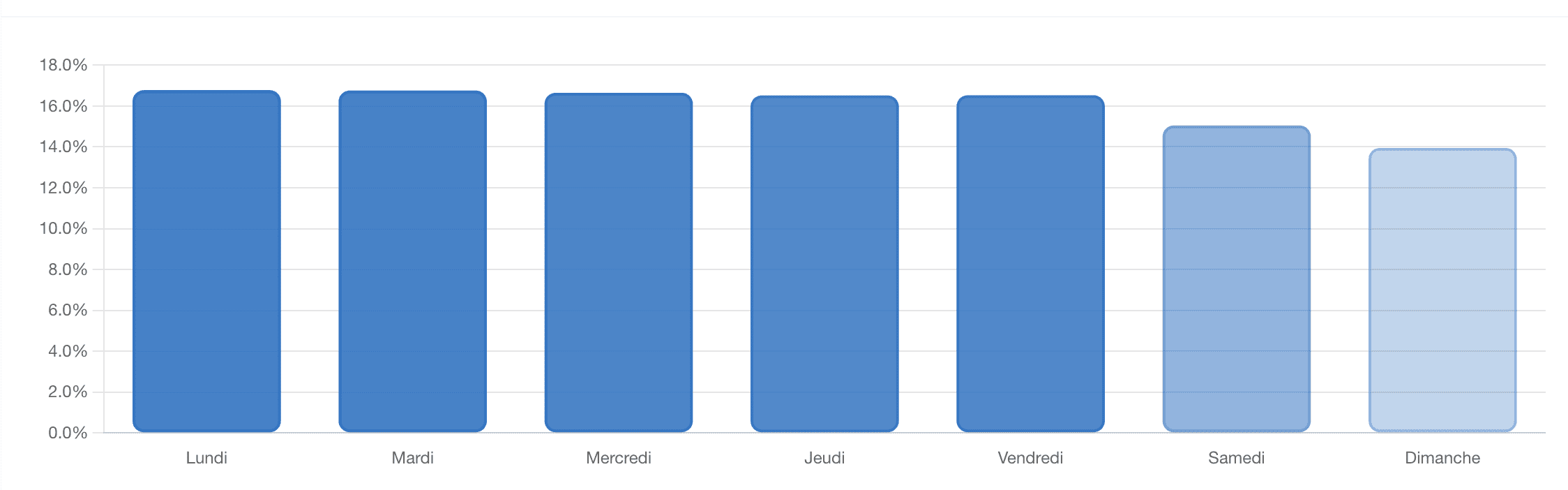
First observation: the days of the week are almost identical. From Monday to Friday, performance fluctuates between 15% and 16%. No marked peak on Tuesday. Weekends drop off a little, to between 13 and 14.5%, which is hardly surprising.
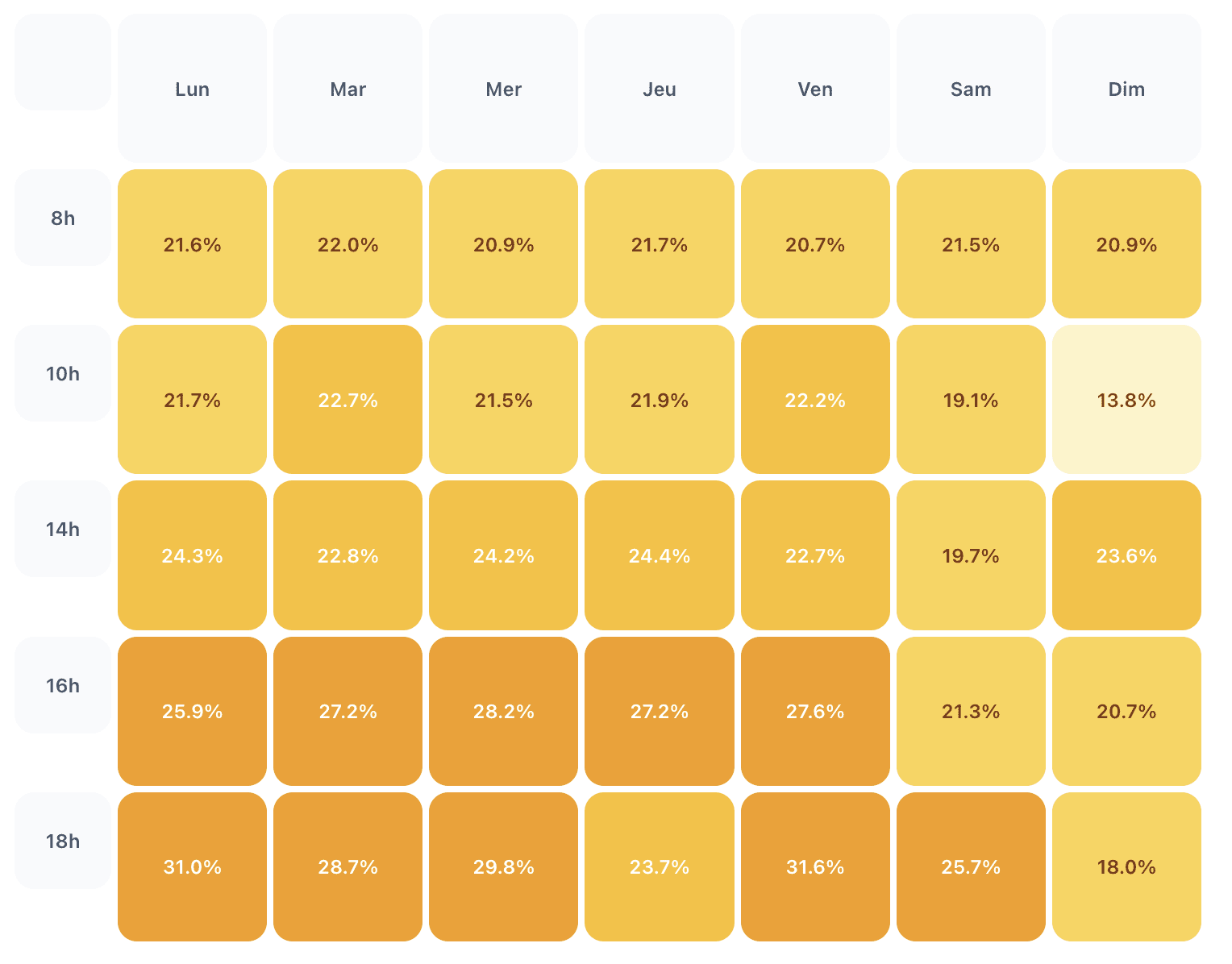
The second, more interesting finding is that the best-performing time slots are not the ones you’d expect. Tuesday at 10 a.m. has an opening rate of 22.7%. Correct, but far from the best score. Wednesday at 4pm climbs to 28.2%. Friday at 6pm peaks at 31.6%.
International data are not completely irrelevant, however. GetResponse, which analyzed 4 billion emails in 2024, confirms that 21% of opens occur within the first hour after sending. HubSpot notes that 47.9% of B2B marketers achieve their best results between 9am and 12pm. But these global averages mask very different local realities.
Why afternoon slots outperform mornings
EmailScope figures show a steady progression throughout the day: around 21% open rate at 8am, 22% at 10am, 24% at 2pm, 27% at 4pm, and up to 31% at 6pm. The trend is clear. There are still a few point differences from one slot to the next, but the trend is unambiguous.
How can we explain this phenomenon? Several factors come into play simultaneously.
Between 8 and 10 in the morning, your inbox is overflowing. All the emails scheduled for the evening before or early in the morning pile up. The recipient’s reflex is to sort quickly: he deletes what doesn’t interest him, processes what’s urgent, and puts off the rest until later. Your prospecting email finds itself drowned in this morning purge.
In the late afternoon, the dynamic changes. The pressure of urgent tasks eases. The professional takes a moment to deal with the emails he or she had put aside, or to consult those that arrive at this time in a less cluttered inbox.
There’s also the collective saturation effect. If all senders follow the same advice and concentrate their mailings on Tuesday mornings, this slot automatically becomes the most competitive. Your message finds itself in competition with dozens of other solicitations.
However, it’s important not to jump to conclusions. These averages conceal disparities according to recipient profiles. An executive who spends his day in meetings will check his e-mails at the end of the day. A craftsman who works in the field all day will do the same, but for different reasons: it’s once the job is finished that he takes the time to check his messages. On the other hand, a marketing manager who sits down at his desk at 8:30 a.m. may be more attentive to his emails in the early morning.
The gap between morning and late afternoon exists, as the data confirm. But it’s a matter of percentage points, not a highly representative order of magnitude. The real lesson is that the morning slot is not always the best. Contrary to what we read everywhere.
Teleworking has reshuffled the cards
Before 2020, business email habits were relatively predictable. Arrive at the office, open Outlook, process mail. The 9am-11am and 2pm-4pm time slots concentrated most of the engagement.
Telecommuting has blurred this pattern. Today, 75% of companies operate in hybrid mode. In France, the average is around 1.7 teleworking days per week. This change has a direct impact on the way professionals check their e-mail.
When you telecommute, the line between work and private life becomes blurred. According to a study relayed by Gallup in 2025, 81% of teleworkers check their work emails outside office hours. Some start as early as 7 a.m., while others stay on until 7 or 8 p.m.
What emerges is a widening of the consultation window. On telecommuting days, the morning peak is less pronounced. No commute, no office ritual. On the other hand, time slots that hardly existed before are gaining in relevance: the early morning before 8am, and especially the late afternoon between 5pm and 7pm.
EmailScope data corroborates this trend. The 6 p.m. time slot consistently achieves the highest scores, whatever the day of the week. Monday at 6pm reaches 31%, Wednesday 29.8%, Friday 31.6%. It’s probably no coincidence that these times coincide with the moment when many professionals, freed from the pressures of the day, take the time to process their boxes.
Mobile consultation also plays a role. According to Litmus, over 41% of email opens are done on a smartphone. At the end of the day, the professional scans his emails with a more available eye than at 9am in front of his to-do list.
Reliable statistics: a prerequisite for sound decision-making
Optimizing your mailing slots presupposes a prerequisite that many people overlook: statistics that reflect reality. But this is not always the case.
The first problem comes from bots. Corporate e-mail security filters (Barracuda, Proofpoint, Microsoft Defender) scan incoming e-mails and automatically click on links to check that they are not malicious. As a result, your dashboard displays opens and clicks that never took place. In some B2B campaigns, click bots and false opens can account for a significant proportion of recorded interactions.
If you analyze your sending niches without filtering out these false signals, you’re optimizing on the basis of polluted data. You run the risk of believing that a niche works best when it’s simply the one where robots are most active.
Ediware includes an optional filter to exclude opens and clicks generated by robots. This can sometimes radically change the way you read a campaign’s performance. An opening rate that seemed excellent can turn out to be much more modest once artificial interactions have been removed.
The second problem concerns Apple Mail Privacy Protection, deployed since iOS 15. This feature pre-loads email images, generating a fictitious “open” even if the recipient has never read the message. Apple Mail accounts for over half of all email opens worldwide, according to Litmus. In other words, the raw open rate has become an increasingly unreliable indicator.
Practical consequence: to compare your mailing slots, rely more on the click-through rate than on the open rate. The click is a voluntary gesture, difficult to simulate. It’s what really tells you whether your e-mail has been read and has aroused interest.
How to find YOUR best niches: the iterative approach
EmailScope data provides an excellent starting point. It indicates general trends in the French B2B market. But your audience has its own habits, and the only way to identify them is by iteration.
The process is simple. Start by selecting a niche based on available industry data. EmailScope allows you to filter by industry from 36 B2B categories, which considerably refines your starting point.
Send your first campaign to this niche. Note the results: click rate (not just open rate, as we’ve seen), response rate if it’s prospecting, and conversions if applicable. For the next campaign, shift the time slot by two or three hours. Compare. Then test on a different day.
A common mistake is to change everything at once. Change only one variable at a time. If you change the sending time, the subject and the content at the same time, you’ll never know what produced the observed effect.
After five or ten campaigns, trends emerge. Perhaps your target group of building tradesmen opens more in the evening, after the job has been completed. Maybe your prospects in the financial sector react better on Wednesday mornings. These lessons are worth more than any general statistics.
And don’t forget seasonality. Consultation habits change during school vacations, May bank holidays and the period between Christmas and New Year’s Day. What works in October won’t necessarily work in August.
The aim is not to find THE perfect niche once and for all. It’s to gradually build up a detailed knowledge of your audience, campaign after campaign.