Is artificial intelligence revolutionizing email marketing? Software publishers and the specialized media are quick to claim so. However, beyond the hype, the reality on the ground is more nuanced. AI does not replace the fundamentals of the profession. It amplifies them. And that’s precisely what makes it so interesting for B2B professionals.
Emailing remains the most profitable direct marketing channel, with an average return on investment of 32 euros for every dollar invested, according to the DMA UK. This figure has not changed, despite the arrival of new channels. What has changed is the way in which each campaign can now be optimized using algorithms.
B2B email marketing has never been so alive
The death of email is regularly heralded. Since 2007, articles have been pitting emailing against social networks and predicting its decline. It has to be said that these predictions have not come true.
Company employees have been using e-mail since the 90s. Its use became widespread in the early 2000s, and unlike the habits of private individuals, who are evolving with instant messaging, business communication patterns remain relatively stable. A B-to-B decision-maker checks his mailbox several times a day. This is where they receive the information that matters to their business.
The average email open rate in 2024 reached 26.6%, up 6% on the previous year according to industry studies. Large companies are even reporting opening rates of 35.53%, suggesting that segmentation and personalization are paying off.
The arrival of AI in this context is not a rupture. Rather, it’s a logical evolution. Emailing platforms are gradually integrating AI functionalities to help marketers target, write and send better. According to Salesforce’s State of Marketing 2024 report, 32% of marketing organizations have already fully integrated AI, and 43% are in the experimentation phase.
What AI means for B2B marketers
Let’s get down to business. What can artificial intelligence really bring to the day-to-day work of a B-to-B marketing or sales manager?
The first benefit is time savings. According to HubSpot’s State of AI survey, AI saves 84% of professionals surveyed time on manual tasks: planning, data entry, repetitive tasks. 64% of them believe that this freed-up time enables them to devote themselves to more creative missions. Less time is spent formatting spreadsheets, and more thinking about strategy.
The second contribution concerns personalization. AI analyzes volumes of data that no human could process manually. It identifies patterns of behavior, preferences and moments that are conducive to engagement. It allows us to adapt the message to each recipient, not in a superficial way with a first name in the subject line, but in a deeper way based on the history of interaction.
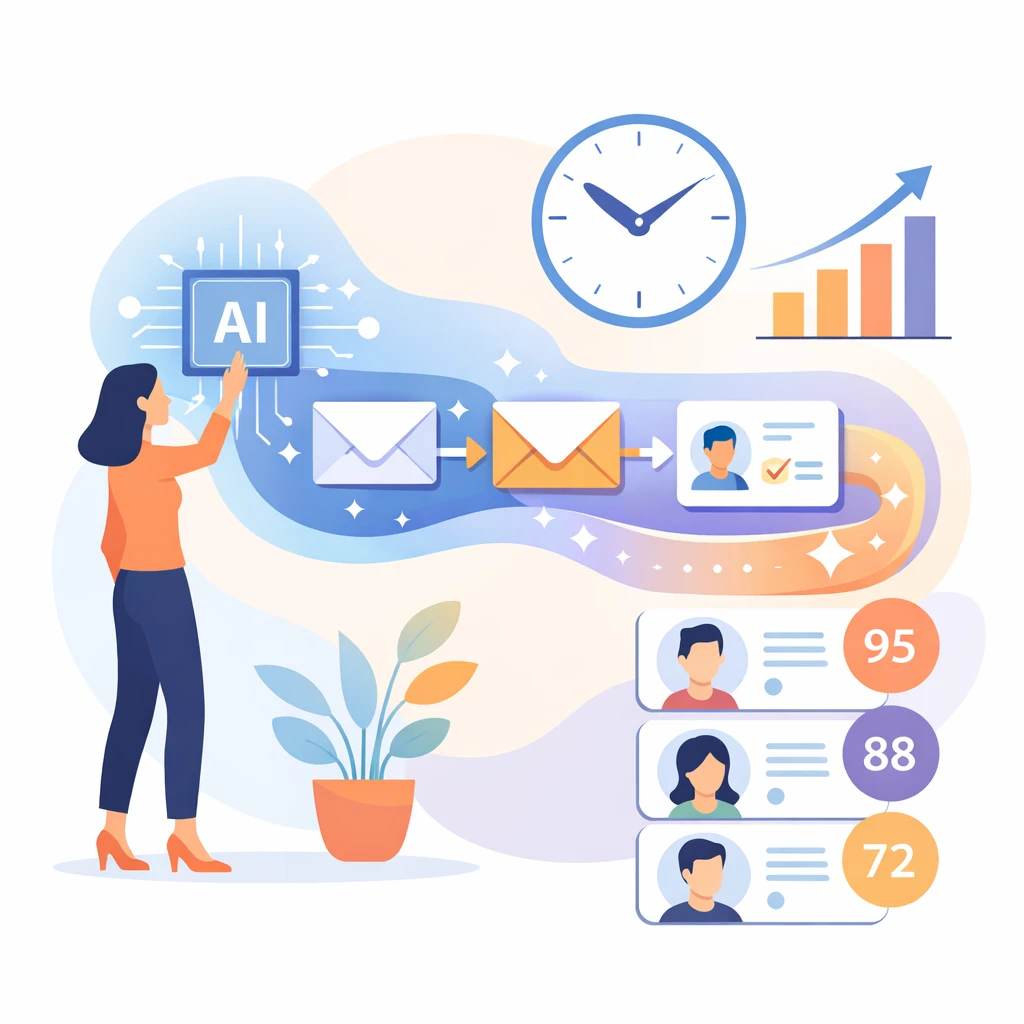
The third contribution is predictive. AI doesn’t just analyze the past. It anticipates. When is the best time to send an e-mail to a given prospect? Which subject line is most likely to be opened? Which contacts are most likely to convert? These questions can now be answered in figures, even if they remain probabilities.
Personalization goes industrial
Personalization is not a new concept in email marketing. For years now, we’ve been inserting the recipient’s first name in the subject line, or adapting content according to industry sector. What changes with AI is the scale at which we can operate.
Emails with dynamic content have a conversion rate three times higher than conventional emails. AI enables this dynamic content to be generated automatically, based on the prospect’s browsing behavior, past interactions and profile.
Let’s take a concrete example. A prospect visits your site, consults a page on deliverability solutions, and downloads a white paper on the subject. AI can automatically trigger a personalized email that takes up this theme, with additional resources adapted to the prospect’s level of maturity in the sales tunnel. With no human intervention required for each mailing.
Marketers who segment their lists see up to 760% increase in revenue generated per email. With AI, audience segmentation becomes dynamic. It adjusts in real time according to observed behaviors, without the need to manually redefine criteria.
But it’s important to keep things in perspective. 93% of consumers feel that the emails they receive are not relevant enough. The bar is high. AI is a powerful tool, but not a magic wand.
Dispatch optimization becomes predictive
What time should you send your campaign? What day of the week? These questions have been on marketers’ minds for as long as they can remember. Traditional answers were based on statistical averages: Tuesday morning, Wednesday afternoon, avoid Monday and Friday.
AI is changing the game. It analyzes the individual behavior of each contact. Pierre opens his emails on Tuesday at 9am, Marie on Thursday at the end of the day. Sending can now be optimized contact by contact, which was unthinkable a few years ago.
The results are measurable. Automated emails have 52% higher open rates than standard campaigns. Their click-through rates are 332% higher. These figures can be explained in part by the relevance of the timing, but also by the consistency of the message with the context of the recipient.
Another promising field of application is email object optimization. AI can suggest object variants, predict their performance, and even perform automated A/B testing on a large scale. Some tools report a 44% increase in sales through automatic optimization of objects and content. These figures should be taken with a grain of salt, as they are highly context-dependent.
AI-powered email marketing would deliver a 13% increase in click-through rates and a 41% increase in revenue, according to Adobe. Again, these results vary according to the maturity of each organization and the quality of the data available.
Scoring and intelligent segmentation
Behavioral scoring has long been a feature of emailing platforms. Contacts are awarded points based on their actions: opening, clicking, visiting the site, downloading. AI enhances this approach in several ways.
First, it takes more signals into account. Not just email interactions, but also website behavior, CRM data, and external signals where available. It builds a more complete profile of each prospect, a 360-degree vision as we sometimes say.
Secondly, it detects patterns invisible to the human eye. Certain combinations of behavior, certain sequences of actions, may indicate an imminent intention to buy. AI identifies these and triggers the right actions at the right time. A salesperson alerted at the precise moment when the prospect is ripe changes everything.
75% of salespeople agree that AI integrations in their CRM boost sales, according to available data. 73% say these integrations make teams more productive.
For teams looking to automate their prospecting, AI offers new possibilities. It makes it possible to prioritize contacts to be processed, identify high-potential accounts, personalize the approach on a large scale without sacrificing quality.
Limits to keep in mind
AI is not a miracle solution. A number of pitfalls lie in wait for organizations that jump in headlong without taking the time to think things through.
The first pitfall concerns data. AI is only as good as the data that feeds it. No more, no less. A poorly qualified contact base, outdated or erroneous data will produce disappointing results. According to the Salesforce report, only 31% of marketers are fully satisfied with their ability to unify their customer data sources. The rest are struggling with silos and inconsistencies.
The second pitfall is the risk of bias. Amazon had to abandon an AI-based recruitment tool after discovering that it discriminated against female applicants. Algorithms reproduce and sometimes amplify the biases present in training data. In email marketing, this can mean over-soliciting certain segments or unintentionally excluding other interesting profiles.
The third pitfall is dehumanization. B-to-B emailing is all about human relations. An email that’s too obviously machine-generated, too smooth, too perfect can arouse distrust. Recipients like to feel that a human being has taken an interest in them, that they’re not just a line in a database.
In fact, only 5% of marketers use AI to write entire articles. 96% of those who use generative AI say they have to make changes to the text before publication. Human intervention remains indispensable, and that’s probably a good thing.
How to integrate AI into your emailing strategy without turning everything upside down
Do we need to rethink everything? Not necessarily. AI can be integrated gradually, starting with the most mature and least risky functionalities.
The first step is to use AI to optimize sending times. Most emailing platforms now offer this feature. It doesn’t require any changes to your content creation processes, just activating the option and letting the algorithm do its work.
The second step is object optimization. AI can suggest variants, automatically test several versions, and identify the formulations that work best with your audience. It’s a good way to familiarize yourself with these tools without taking any major risks.
The third, more advanced stage involves dynamic content personalization. It requires good data quality and careful consideration of the different scenarios to be covered. It’s not something to be undertaken lightly, but the results can be significant.
By 2024, 81% of B2B decision-makers consider it important for their emailing software to incorporate AI functionality. The demand is there. So is the supply. What remains is to find the right balance between automation and human control.
The key is to keep control of the strategy. AI optimizes execution, it doesn’t define objectives. It’s up to you to decide what message you want to get across, to whom, and why. AI simply helps you do it more efficiently, with less repetitive effort and more relevance.
Frequently asked questions about AI and B2B email marketing
CAN IA WRITE ALL MY PROSPECTING EMAILS?
Technically yes, but not recommended. AI-generated texts almost always need tweaking to sound natural and reflect your brand tone. Instead, use AI for suggestions and a first draft that you can then rework.
WHAT BUDGET SHOULD YOU SET ASIDE TO INTEGRATE IA INTO YOUR EMAILING STRATEGY?
Most AI functionalities are now integrated into existing emailing platforms. The additional cost is often nil or marginal. What requires investment is data quality and team training in these new tools.
WILL IA REPLACE MARKETING TEAMS?
No. AI automates repetitive tasks and assists decision-making. It does not replace creativity, strategy and in-depth customer knowledge. Marketing teams that master AI become more efficient, they don’t disappear.
HOW DO I KNOW IF MY EMAILS ARE PERCEIVED AS GENERATED BY IA?
An email that’s too perfect, without asperity, with consensual wording can arouse suspicion. Keep your style personal, add contextual references and vary your sentence structure. Authenticity is the best antidote to mistrust.
WHAT ARE THE MOST USEFUL IA FEATURES FOR B2B EMAIL MARKETING?
Optimization of sending times and predictive scoring offer the fastest results. Dynamic content personalization requires more maturity, but generates the best long-term returns.
DOES IA REALLY IMPROVE DELIVERABILITY?
Indirectly, yes. By sending more relevant messages at the right times, you improve your engagement rates. Messaging providers interpret these signals positively, which helps your campaigns reach the inbox.
SHOULD YOU TELL YOUR CONTACTS YOU’RE USING IA?
There is no legal obligation to do so for email marketing. Common sense suggests remaining transparent if the question arises. What really counts is the value brought to the recipient, not the method used to produce it.